A linear accelerator comes out of its vault in pieces, never in one lift. The work runs in a fixed order: a medical physicist surveys the room and issues a written release, the OEM de-installs and disconnects, then the couch, head, gantry and drive stand are rigged out through the maze or a removable shield panel, skated to the dock, crated and shipped to the new vault.
A linear accelerator is the hardest single machine in a hospital to relocate, and it has almost nothing to do with the weight. A linac lives inside a concrete vault that was poured around it, reached through a shielded maze that was never sized for the machine to come back out, and it cannot be touched at all until a medical physicist says so in writing. The rigging is real work, but the rigging is not what makes or breaks the schedule. Sequence is.
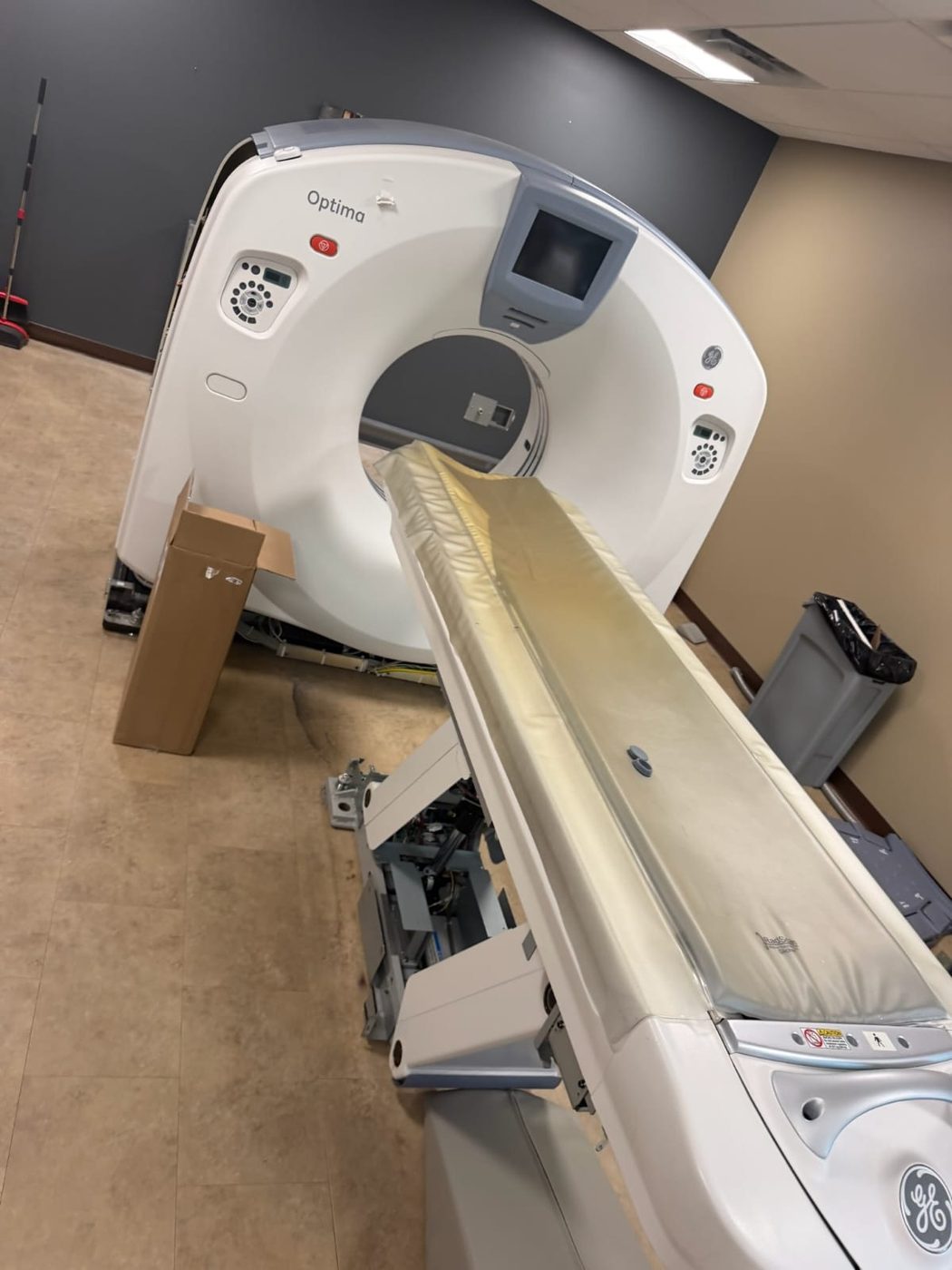
Why is moving a linear accelerator different from any other machine?
Because the room is part of the machine. A treatment vault has primary barriers that are typically several feet of concrete, an entry maze rather than a straight door, and in many designs a shielded door weighing thousands of pounds. The linac was set on its base before the last wall or the roof plug went in. Nothing about that room was designed around removal.
On top of that, the system is not one object. The drive stand, the gantry, the head with its multileaf collimator, the imaging arms, the patient couch, the modulator and control cabinets, the water chiller and the console are all separate items with separate handling rules. Depending on the model, the gantry and drive stand carry most of the system's weight in one indivisible piece — several tons — and the rest is spread across a dozen crates. The real weights and the clearance envelopes come out of the manufacturer's site-planning guide, not out of anybody's memory.
What has to happen before a linac can be touched?
A written radiation release from the facility's medical physicist or radiation safety officer. A standard medical linac holds no sealed radioactive source — it makes radiation only while it is energized — but a high-energy machine running above roughly 10 MV can leave short-lived activation products in the head and target region. The physicist surveys the machine after beam-off, waits out the decay if there is any, and releases the equipment and the room. Riggers do not start, and crates do not open, before that document exists.
Two other items belong in the same conversation. The machine is registered with the state radiation-control program, and that program has to be told when it is removed or disposed of. And if the device in the vault is a cobalt-60 unit or a Gamma Knife rather than a linac, everything above changes: those hold sealed sources, and source handling is licensed work that goes to a licensed source-services contractor before any rigging is scheduled.
Who does the de-installation?
The OEM, or a third-party service organization that supports the platform. They power the system down, drain and cap the cooling loop, break the waveguide and cable connections, remove the head components and imaging arms, and separate the gantry from the drive stand in the order the service manual specifies. Getting that sequence wrong damages parts that are not casually replaceable.
The split of work is worth writing into the scope on day one, because it is the most common gap between quotes. Roughly: the OEM owns anything that unbolts from the machine, the facility's trades own power, chilled water, compressed air and network, and the rigging crew owns everything from the moment a component is on its own feet to the moment it is set on the new floor. When one of those three assumes another is handling the chiller on the roof, the job stops on a Saturday night.
How does a linac get out of a shielded vault?
One of three ways, and the site walk is what decides which.
Through the maze. If the components break down small enough and the maze turns are wide enough, everything walks out the way people do. This is the cheapest path and the one everyone hopes for. It is also the one that gets assumed instead of measured. The binding constraint is almost never the door opening — it is the turn radius at the corner of the maze, with a long, heavy, top-tender piece on skates and no room to swing it.
Through a knock-out panel. Many vaults were built with a removable shield section — a block wall, a separately poured panel with lift inserts, or a roof plug — precisely so the machine could be changed out. If the drawings show one, that is usually the answer, and the panel itself becomes a rigging item in its own right. If the drawings do not show one, the panel has to be created: wall sawing or wire sawing the barrier, which is structural work that needs an engineer's sign-off, shoring, containment for slurry and dust, and a plan to restore the shielding to the physicist's satisfaction afterward.
Through the roof. Where the vault sits under an accessible roof and the department cannot be cut into, the components go vertically. That is a crane pick with a lift plan, a closed staging area below, and a weather window. It is the most disruptive option and sometimes the only one.
What the site walk has to capture
- Maze geometry — every turn, width and ceiling height, measured, not taken off a drawing
- Shield door weight and whether it has to be removed to clear the opening
- Whether a knock-out panel or roof plug exists, and what the drawings say about restoring it
- Floor capacity on the whole path outside the vault, including the corridor and lobby
- Elevator rating and internal dimensions, or the absence of one that qualifies
- Where the chiller, modulator cabinets and console live — they are rarely in the vault
- Door and threshold heights between the vault and the dock, and dock height itself
How are the pieces moved once they are out?
Low and slow, on steel. The vault slab will take anything; the trouble starts at the threshold. Heavy components ride on machinery skates or roller systems, jacked up with toe jacks rather than lifted, with steel plate laid over floor joints, thresholds and any corridor that was not poured for this. Ceiling height in a maze is often too low for a forklift mast, which is why a hydraulic gantry or jacking and skidding does the work inside the room and the forklift or crane only meets the load outside.
Once it is on the dock, the shipping standard is the same one that applies to MRI scanners and other imaging systems: enclosed and air-ride, crated or heavily wrapped, blocked and braced so nothing can walk, and on high-value components shipped with shock indicators so rough handling is visible on arrival. Transport between sites moves through our licensed broker and carrier partners.
How is an old linear accelerator decommissioned?
An older machine coming out for a replacement usually is not going anywhere else. Once the physicist has released it and the state has been notified, the components are separated for salvage: copper, steel, lead shielding from the head, and the electronics. Lead is handled as a regulated material rather than scrapped casually, and the head shielding is heavier than it looks.
The vault itself is a separate decision the owner makes. Some are reused for the new machine — the common case, since the shielding was the expensive part. Some are converted, which means the barriers can stay in place as long as nobody needs the floor area back. Demolishing a vault is a specialist job and well outside a rigging scope. What matters to the move is that the removal of the old machine and the installation of the new one are usually back-to-back in the same room, which is where the schedule pressure comes from. See equipment removal and decommissioning for how the disposal side is handled on industrial work.
How long does a linac changeout take?
Plan in weeks, not days, and plan the department around it rather than the other way round. The rigging windows themselves are short — a de-install and rig-out is typically a matter of days once the room is released — but they sit inside a much longer sequence: physics survey and release, OEM de-install, rig-out, any shield restoration, the new machine's rig-in, OEM installation and calibration, and then acceptance testing and commissioning by the physicist before a single patient is treated. The commissioning tail is usually the longest piece and it belongs to the physicist, not the rigger.
The practical consequence is that the vault is out of service for the whole run, and patients on treatment have to be transferred to another machine or another site. That is why so much of this work happens on nights and weekends, and why a crew showing up to find the chilled-water line still charged costs more than the overtime it was meant to save.
What gets missed on linac moves?
- The maze turn. Measured at the corner with the actual component footprint, not eyeballed at the entrance.
- The shield door. On door-equipped vaults it often has to come off, and it is a rigging item with its own weight and its own track.
- Everything outside the room. Chiller, modulator, cabinets, console, lasers, interlocks and CCTV are all part of the system and all in different rooms.
- The path past the vault. Vault floors are heavy slab; the corridor, the lobby tile and the elevator lobby usually are not.
- The release. No written physics release, no work — and it is the item most likely to be assumed rather than confirmed.
- Infection control and access. Oncology departments run barrier, route and elevator-embargo rules that shape the crew's path as hard as any dimension does.
Bottom line
- A linac leaves the vault in components, and the sequence is set by the service manual, not by the crew.
- Nothing starts before the medical physicist's written release; cobalt-60 units are a different, licensed job entirely.
- The exit is the maze, a knock-out panel, or the roof — and the maze turn is the measurement people skip.
- The OEM, the facility trades and the rigging crew each own a slice; write the split down before the first shift.
- The vault is out of service through commissioning, so the schedule is a department problem, not a moving problem.
Planning a linac changeout, a vault reuse, or a whole oncology department move? This is core medical equipment rigging work. Send the model, the vault drawings and the path out of the building, and we will build the plan — start here. For the department-level picture, see the relocation checklist and how a CT scanner move runs.