An MRI scanner is one of the hardest things you can ask a crew to move. It is heavy — a magnet can run from roughly 5,000 to well over 12,000 lbs — and at the same time it is delicate, expensive, and intolerant of shock, tilt, and temperature swings. Move it wrong and you are not paying for a scuffed crate; you are paying to re-cool a magnet or replace a multi-hundred-thousand-dollar machine. This is rigging and engineering, not a two-guys-and-a-dolly job.
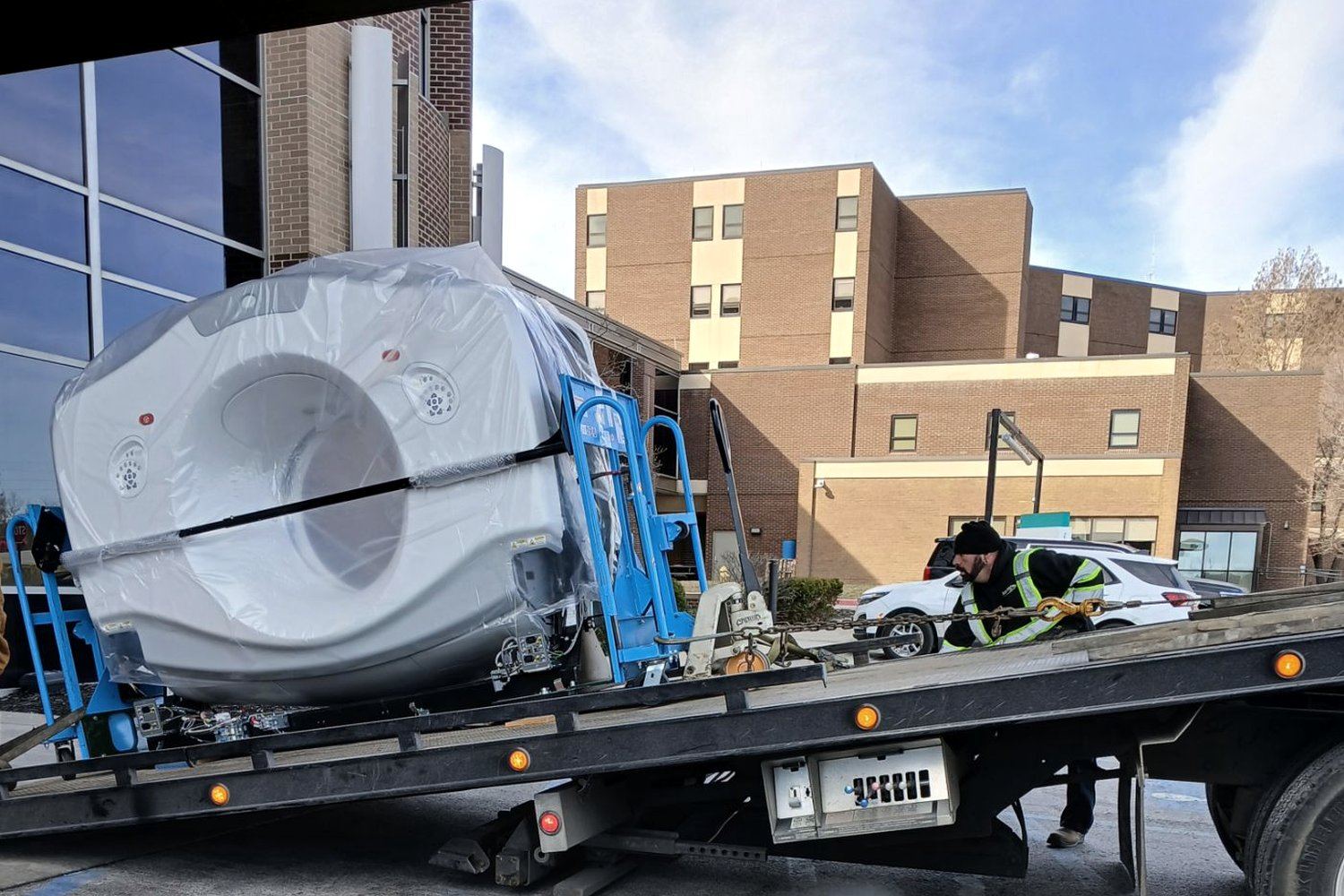
Why an MRI move is different
- The magnet. The superconducting magnet is the heart — and the hazard. Many moves are done with the magnet at field-off / ramped-down state, coordinated with the OEM, and some require managing or recovering cryogens (liquid helium).
- Shock and tilt limits. Manufacturers set strict shock-and-tilt thresholds. We use monitored, controlled lifts and air-ride transport to stay inside them, and often ship with shock indicators on the crate.
- The fringe field. Until it is de-energized, the magnet's field is a serious safety issue around ferrous tools and equipment. Planning respects that.
- It rarely fits the door. MRIs were often installed before the walls went up. Getting one out can mean removing windows or wall panels, or craning it in or out through the roof.
How the move actually gets done
1. Site survey and path of travel
We measure everything: the machine, every doorway, corridor, elevator, and turn between the magnet room and the truck — plus floor loading along the route. Nothing is guessed. If the path does not work at ground level, we plan a crane-in or crane-out.
2. Rigging the magnet out
The magnet is jacked, skated, and rolled along an engineered path on air skates or rollers, or lifted under control with a gantry or crane. Tight-access and rooftop jobs get a planned crane lift, and the transport is run as project freight so the crane, the truck, and the crew all show up on the same plan.
3. Transport
The scanner ships secured and shock-monitored on air-ride equipment, climate-considered, and routed to avoid rough roads where we can. Transport runs as project freight on air-ride partner equipment, planned with the rigging — one accountable team from the hospital floor to the new suite.
4. Set, place, and hand off
At the destination we reverse the process — rig it in, set it on its pad, level it — and hand off to the OEM service team for ramp-up, calibration, and clinical sign-off.
What drives MRI move cost
Magnet weight and model · whether it craned in/out or rolled out a door · distance and access on both ends · crane and rigging gear required · OEM coordination and cryogen handling · how much wall/window/roof work the path needs.
What should you look for in an MRI rigging company?
Look for a crew that treats the move as engineering, not muscle. In our MRI rigging work, the path of travel is surveyed before rig day — every doorway, corridor, elevator, and floor-load rating between the magnet room and the truck gets measured, and if the path does not work at ground level we plan a crane-in or crane-out instead of forcing it. The magnet itself — typically 5,000 to over 12,000 lbs for a superconducting unit — rides skates or rollers along that planned path, ships secured on air-ride equipment, and the whole schedule is coordinated with the OEM's field service engineers around ramp-down and cryogen handling. We have rigged and hauled MRI and medical equipment at live hospital sites on tight clinical timelines — the photos in this guide are from our own moves. See the MRI & medical equipment rigging section of our rigging service for more.
Moving a scanner, CT, or other imaging equipment? Send us the model, the floor, and the dates — we'll plan the lift.