Moving a laser cutter means protecting the beam delivery path, not just the base. A CO2 machine’s resonator and beam-folding mirrors travel locked or removed per the OEM brief; a fiber machine’s sealed source rides on its own shock isolation. The chiller drains and moves separately, assist-gas cylinders ship disconnected, and on reinstall the beam path gets verified before the first cut.
A laser cutting machine does not look hard to move. There is no chuck, no tool changer, no ram — from the outside it is a flat bed, a gantry, and a cabinet. What is easy to miss is that the thing doing the actual cutting is either an invisible beam traveling through a chain of mirrors to the head, or a sealed fiber-delivery system that has no tolerance for the kind of shock a forklift ride hands out without thinking about it. Get the beam delivery wrong and the machine reassembles, powers up, and cuts a ragged edge instead of a clean one — with nothing obviously broken to point at.
Fiber and CO2 machines share a bed, a gantry and a cutting head, but the two handle a move differently once you get past the sheet metal. Treating a fiber laser's move plan like a CO2 machine's is the single most common way this job goes sideways.
What is the difference between moving a CO2 laser and a fiber laser?
A CO2 laser generates its beam inside a resonator and steers it to the cutting head through external mirrors, so the move has to protect an open optical path; a fiber laser generates the beam in a sealed source unit and delivers it through an armored fiber-optic cable, so the move protects a sealed, factory-aligned system instead. That difference changes almost everything about how each machine gets handled.
On a CO2 machine, the resonator sits in or near the cabinet and fires the beam through a chain of bend mirrors — usually three or more — mounted at each turn the beam takes to the cutting head. Every mirror is aligned to a fraction of a millimeter and is a potential misalignment point if the machine gets bumped, tilted past its rated angle, or set down hard. The resonator itself, especially on older sealed-tube CO2 units, is also shock-sensitive internally.
On a fiber machine, there is no open beam path to protect. The laser source — the box that generates the beam — connects to the head through an armored fiber-optic delivery cable, a manufactured, factory-terminated assembly a rigging crew does not disconnect and reconnect in the field. The source unit is the fragile item: a precision electronics package built around laser diodes that tolerates handling better than an open optical path, but still ships on its own shock isolation, not treated as just another cabinet.
How do you handle the resonator or beam path on a CO2 laser?
By locking or removing what the OEM shipping brief tells you to lock or remove, never assuming the beam path survives untouched just because nothing looks knocked loose. Every CO2 builder publishes a pre-transport procedure for this, worth pulling before anyone touches the machine rather than improvising one on the floor.
The general sequence across most CO2 platforms:
- Park the gantry and head at the position the manual specifies — usually centered or home — before power-down, so the beam-folding mirrors sit at a known, protected orientation.
- Lock the axes. Transit brackets or the machine's own axis locks keep the gantry, Y-carriage and Z-height head from sliding under road vibration. A head that shifts on its rail can rack the mirror mount enough to throw off alignment even if the mirror is never touched directly.
- Protect or remove the bend mirrors per the OEM brief. Some builders spec leaving mirror housings sealed and locked for a short local move; others want the final mirror ahead of the head removed and crated separately, since it takes the most shock through the head assembly. Follow the specific documentation, not a generic rule.
- Cap the nozzle and lens housing. The focusing lens sits right behind the nozzle where the beam exits, as exposed to dust and impact as anything on the machine.
- Sealed-tube resonators get their own note. Older sealed-tube CO2 resonators are glass-tube assemblies, more shock-sensitive than the RF-excited metal or ceramic resonators on newer machines. If the documentation calls for the resonator to travel isolated from the main frame, that takes priority over convenience.
None of this is a judgment call to make on site. A CO2 beam path is a chain of precision optics already aligned once at the factory or by a service tech, and every step here exists to keep that alignment from being what pays for a fast move.
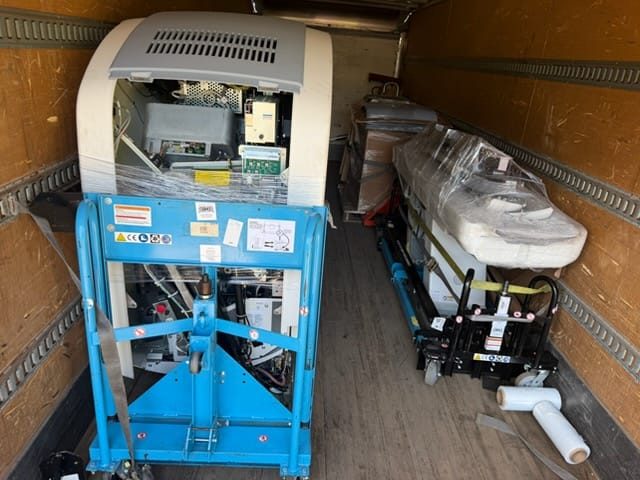
How do you move the source unit on a fiber laser?
As its own isolated item, disconnected from the delivery cable at the connector the manufacturer specifies, and rigged on its own shock-isolated skid rather than bolted to the main frame and carried along with it. Fiber sources are more forgiving of ordinary handling shock than an open CO2 beam path, but "more forgiving" is not "not fragile" — the diode arrays and internal optics still have limits most builders publish as tilt and shock thresholds.
The delivery cable itself is what crews get wrong most often. It is armored, but it has a minimum bend radius, and it is not a cable to coil tight, kink, or let drag off the back of a cart. If the source and the gantry-mounted head are being separated for the move — common on larger installations where the source lives in its own cabinet away from the bed — the cable gets protected in its full service loop or capped at both connectors and coiled to spec, never forced into a smaller loop to save crate space. Higher-power installations with beam switches or multiple heads off one source add junction boxes and extra fiber runs, and each connector and bend radius gets identified on the site walk before disconnection, not figured out in the moment.
What the site walk has to capture
- CO2 or fiber, and the exact model — the OEM shipping brief differs by both
- Resonator or source unit location, weight and whether it is integral to the frame or a separate cabinet
- Number and position of beam-folding mirrors on a CO2 machine
- Fiber delivery cable length, connector type and minimum bend radius on a fiber machine
- Chiller model, coolant type and capacity — often two independent loops on higher-power machines
- Assist-gas setup: cylinder manifold, in-house generator, or bulk supply, and what stays versus what ships
- Bed and gantry weight from the data plate, plus rail and drive condition for the reinstall alignment check
What has to be done with the chiller before the machine moves?
Drained, disconnected as its own item, and never left plumbed to the machine for the ride. A laser cutter's chiller cools the resonator on a CO2 machine or the source and head on a fiber machine, and on higher-power installations there are often two separate cooling loops running at different temperatures — one for the laser generation side, one for the optics or cutting head. Both get identified and handled independently: drained into approved containers, flushed per the manufacturer's procedure, lines capped the moment they disconnect, then rigged as a standalone unit.
Coolant on a laser system is typically a deionized or distilled water and glycol mix, sometimes with a specific conductivity requirement for the laser side of the circuit — not a fluid to top off with tap water at the new site. Refill with the OEM-specified coolant on reinstall, and confirm the conductivity or purity spec is met before the chiller is powered up, because the wrong coolant chemistry degrades resonator or optics life quietly, with no immediate warning.
How do you handle assist gas and cylinders?
Disconnected from the machine's gas manifold, purged of line pressure, and shipped separately under standard compressed-gas rules — never loaded loose in with the machine. Laser cutters run assist gas — oxygen for mild steel, nitrogen for stainless and aluminum, sometimes compressed air — fed from cylinder banks, a bulk tank, or an in-house nitrogen generator plumbed into the shop's gas lines.
What moves and what does not depends on the setup. Cylinders and their manifold regulators disconnect from the machine's gas inlet and travel separate from the general freight. An in-house nitrogen generator, if the installation has one, gets assessed as its own piece of equipment with its own reinstall and requalification, not assumed to plug back in and perform to spec on day one. Either way, the machine's own gas lines and solenoids get capped at the disconnect point so no debris or moisture gets into a system sized for clean, dry gas at a specific purity.
What shock limits apply in transit?
Whatever the manufacturer specifies for that model — worth getting that number rather than assuming "handle like any other CNC" covers it. Beam delivery components often carry tighter shock and tilt thresholds than a comparable mill or press because the tolerance stack is optical, not mechanical — a way surface can absorb a little imprecision, a mirror mount or a fiber connector cannot.
In practice, the bed and gantry get blocked and strapped along their full length, not at two points, with every axis locked with OEM travel brackets or purpose-built blocking. The resonator, source unit or any crated optics ride with shock indicators where the load value justifies it, loaded last so they are not the first thing handled at either end. Transport between sites runs through our licensed broker and carrier partners on a covered trailer — an open deck exposes optics and control electronics to road grit and weather that a sealed cabinet does not normally see.
How do you realign a laser cutter after reinstall?
By treating the beam path as unverified until checked, not by assuming the machine powers up ready to cut. On a CO2 machine, that means running the resonator and bend-mirror alignment procedure — most builders provide a beam-alignment target or burn-pattern test confirming the beam is centered through every mirror and hitting the nozzle dead center before any material loads. Skip this and cut straight off the truck, and a shop discovers a mirror walked out of alignment by burning through a nozzle instead of a workpiece.
On a fiber machine, the source-to-head connection is factory-terminated and does not need the same field alignment a CO2 beam path does, but the cutting head still needs its own checks: nozzle concentricity, focus height calibration, and confirming the beam is centered in the nozzle orifice, usually through the machine's own diagnostic cycle. Bed flatness and gantry squareness get verified on both machine types the same way they would on any large-format tool, because a twisted bed throws off cut squareness on large sheets even with a perfectly aligned beam.
Only after alignment checks, a coolant fill at spec, and pressure-tested gas lines should the machine run a test cut against known material — comparing edge quality and dimensional accuracy to a pre-move baseline cut, if one was taken before the machine left the old site. That baseline is worth five minutes before disconnection and saves a lot of guessing after reinstall.
Bottom line
- CO2 machines protect an open beam path — resonator and bend mirrors get locked or removed to the OEM brief. Fiber machines protect a sealed source unit and its armored delivery cable.
- The chiller drains and moves as its own item, on its own loop if the machine runs more than one, refilled to the exact coolant spec before power-up.
- Assist-gas cylinders disconnect and ship under standard compressed-gas rules; in-house nitrogen generators get treated as their own reinstall.
- Shock and tilt limits are tighter on beam-delivery components than on comparable mechanical machine tools — get the OEM's actual numbers.
- Reinstall is not complete at power-up. Beam alignment, nozzle concentricity and a test cut against a known baseline come before the machine goes back into production.
Moving a fiber or CO2 laser cutter, or a full fabrication cell as part of a larger relocation? That is machinery moving handled with the same discipline as any other CNC machine move. Send the model, the source configuration and the room layout and we will build the plan — start here.