To move an EDM machine, drain and dispose of the dielectric fluid as regulated waste, then disconnect the filtration or chiller unit as its own item, not plumbed to the machine. Wire guides, the drum and tension rollers get capped or removed. On reinstall, level to OEM tolerance and let it reach thermal stability before cutting — a bad level shows as taper, not a machine that refuses to run.
An EDM machine looks unglamorous on the shop floor — a tank, a head, a control cabinet, maybe a chiller humming in the corner — and that is exactly why it gets underestimated on a move. There is no cutting tool to protect, no clamp to lock, nothing that looks like it minds being tilted. What actually decides whether the machine cuts to tolerance again is a fluid system most riggers have never drained, a wire path with tolerances measured in microns, and a machine base that has to come back dead level or the spark gap starts drifting from one corner of the work envelope to the other.
Wire EDM and sinker (ram) EDM are different machines with different move problems, but they share the same three things that get skipped when a crew treats this like any other CNC: the dielectric, the filtration unit, and the level.
What is dielectric fluid and why does it matter for the move?
Dielectric fluid is the medium the machine sparks through, and it is the first thing that has to come out before anything gets rigged. Sinker EDMs typically run a hydrocarbon-based dielectric oil in an open tank around the workpiece; wire EDMs run deionized water, circulated through a resin bed that strips out the conductivity the spark generates as it erodes metal and ionizes the fluid.
Neither one goes down a floor drain. Dielectric oil is a petroleum product that has been picking up eroded metal particulates for the life of the tank, and most jurisdictions treat used EDM oil the same way they treat other used cutting and dielectric oils — as a waste stream that gets drummed and manifested to a licensed handler, not dumped. Wire EDM's deionized water is cleaner going in, but by the time it comes out of a working machine it has been through a resin bed loaded with dissolved metal and is not something to run to the sanitary sewer without checking the local discharge rules first. On both machine types, the drain plan gets decided before the tank is opened, not while it is draining onto the floor.
Practically, that means: pump or drain the tank into approved containers, flush the lines the manufacturer specifies for a flush cycle, and get the fluid classified and manifested for disposal or, if the plant has a reason to keep it, transported as a hazardous or regulated liquid under its own paperwork — not loaded loose in the same load as the machine.
How do you handle the filtration and chiller units?
As separate items, disconnected and rigged on their own, not left plumbed to the machine and dragged along behind it. A sinker EDM's paper or cartridge filtration cart and a wire EDM's deionized-water resin/filter skid both sit outside the main casting, connected by hose, and both get treated as their own move:
- Drain and depressurize the cart. Filtration units hold their own reservoir of fluid, separate from the tank. That gets drained through the same disposal path as the main fluid before the cart is disconnected.
- Cap every line. Supply, return and any bypass hoses get capped the moment they come off, both to stop drips in transit and to keep contamination out of the fittings.
- Replace or bag the filter media. A cartridge or bag filter that has been pulling metal fines all week is heavy, saturated and not something that rides well. Swap it for a fresh element before the move, or at minimum bag the spent one for disposal rather than letting it ride wet in the cart.
- Service the resin bed on a wire machine. Deionization resin has a service life, and a move is a normal point to check conductivity and swap the resin rather than reconnect a spent bed and wonder why the cut quality is off two weeks later.
- Rig the chiller separately. Machines with a dedicated dielectric or spindle chiller drain the water/glycol side, cap the lines and move it as its own skid. It reconnects at the new site with fresh coolant, not whatever was left standing in the lines.
None of this is exotic rigging — a filtration cart is a rollaround appliance, not a crane pick. The point is that it does not travel bolted to the machine's plumbing, because hose fittings are not a structural connection and a cart bouncing on its own hoses in transit is how a fitting cracks.
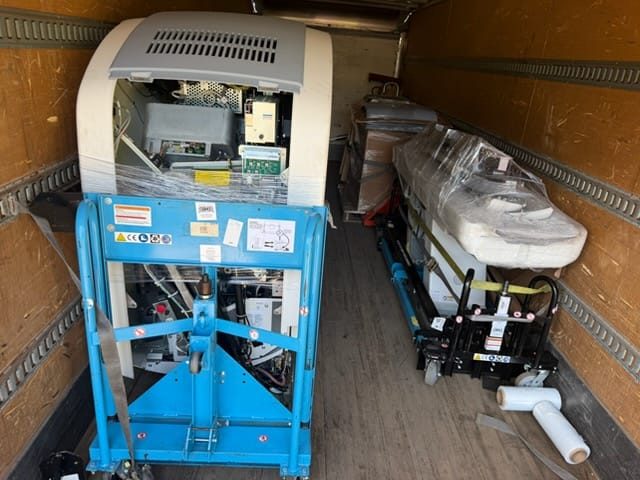
What has to be done to protect the wire path on a wire EDM?
The upper and lower guide heads, the wire drum, the tension and feed rollers, and the flushing nozzles are all precision components set to tolerances a stray bump will ruin, so they get protected or removed before the machine moves, not left exposed on the travel envelope. The guides in particular — diamond or carbide inserts that the wire rides through on its way to the workpiece — are small, expensive, and sit exposed on the Z-axis head where a forklift, a doorframe or a careless hand can catch them.
The practical sequence: retract the axes to a travel-safe position per the OEM manual, remove the spool of wire if it is not staying loaded, back the upper and lower guide assemblies off to their protected position or remove them per the service manual, and cap or bag the flushing nozzles so grit does not get packed into them during transit. The wire drum and any automatic threading mechanism get checked against the manufacturer's shipping brief — most builders publish a specific pre-move checklist for exactly this, and it is worth pulling before the machine is touched rather than improvising one.
On a sinker EDM there is no wire path, but the equivalent fragile items are the electrode, the ram head and its guiding, and the servo head — the electrode comes off and travels in its own fixture rather than staying chucked in the ram, and the ram head gets locked or blocked against its own travel the same way a machining center's Z-axis gets locked for a move.
What the site walk has to capture
- Dielectric type (oil or deionized water) and tank capacity, for disposal and container planning
- Filtration cart and chiller as separate line items with their own dimensions and weight
- OEM shipping brief for the wire path, guide heads and drum, if the builder publishes one
- Base and tank weight from the data plate, plus center of gravity — tanks are often off-center
- Floor condition and level at both ends; EDM tolerance work does not forgive a soft or uneven slab
- Power feed and, on wire machines, the deionization/resin system's service history
- Room temperature stability at the new location, away from doors, direct sun and HVAC vents
How is an EDM machine rigged and blocked for transport?
From the base casting, at the manufacturer's designated lift and jack points, the same rule as any precision machine tool — never from the tank rim, the head, the guide assemblies or the control cabinet. A sinker EDM's dielectric tank is often an integral weldment with the base, which changes where the real center of gravity sits once the oil is out versus in; get that weight distribution from the manual rather than eyeballing it, because an empty tank shifts the balance point noticeably compared to a full one.
In the trailer, the machine blocks and straps along the full length of the base, not at two points, and every axis that can slide or drop under vibration — the Z-axis head, the worktable, the wire drum if it stayed mounted — gets locked with the OEM's travel brackets or with blocking built for the purpose. Control cabinets and servo drives ride protected from moisture the same way they would on any CNC move. Transport between sites is arranged through our licensed broker and carrier partners, on a covered trailer, because an open deck exposes precision guideways and control electronics to road grit and weather that a sealed EDM tank does not normally see.
Why does an EDM punish a sloppy level more than other machine tools?
Because the spark gap the whole process depends on is measured in thousandths of an inch, and that gap has to stay consistent across the entire work envelope. A vertical mill with a base that is slightly out of level still cuts — it just wanders a little on very long, very precise work. An EDM is different: the erosion process is controlled by the gap distance and the flushing of the dielectric through that gap, and a base that is twisted or out of level changes the geometry of the head relative to the table across the travel, which shows up as taper, poor surface finish, or dimensional drift between one corner of a part and the other.
On reinstall, the machine goes onto its leveling pads or mounts on a slab that can carry the weight without settling, and gets leveled to the OEM's specification — typically checked with a precision level across both axes of the table travel, not just at the center. On a wire machine, squareness of the upper and lower guide heads to the table gets re-verified after leveling, because guide alignment and base level interact; a base that is out will pull the guides out of square even if they were set correctly on the bench. Anchoring, where the machine calls for it, is straightforward millwright work, and it happens before any wire is threaded or any electrode is chucked, not after.
Why does thermal stability matter before you cut anything?
Because EDM accuracy depends on the machine's structure and fluid system sitting at a stable, uniform temperature, and a machine that just landed after a truck ride and a level check has not gotten there yet. The dielectric system, the base casting and the control electronics all need to soak at ambient shop temperature — most manufacturers publish a soak time before precision work should be attempted, often measured in hours rather than minutes for a machine that traveled any real distance or sat in a cold trailer overnight.
This is also why room placement matters more for an EDM than for a lot of other machine tools: away from bay doors, direct sun through a window, and HVAC supply vents that cycle the ambient temperature around the machine. A shop that runs tight tolerances on other equipment already treats this as normal practice; an EDM is simply less forgiving of skipping it. Fill the dielectric system with fresh or filtered fluid, run the machine through its warm-up cycle, and cut a test piece against a known dimension before it goes back into production — the same discipline covered in machine leveling and alignment for any tolerance-sensitive tool.
Bottom line
- Dielectric fluid — oil or deionized water — is drained and disposed of as a regulated waste, never dumped.
- The filtration cart and chiller are separate items: drained, capped and rigged on their own, not dragged behind the machine.
- Wire guides, the wire drum and flushing nozzles get protected or removed to the OEM's shipping brief before the machine moves.
- Lift and block on the base at designated points only — never the tank rim, the head or the guide assemblies.
- Level to the OEM tolerance and let the machine reach thermal stability before it cuts to size. A sloppy level shows up as taper and drift, not a machine that refuses to run.
Moving a wire or sinker EDM, a whole EDM department, or a tolerance-sensitive machine shop? That is machinery moving handled with the same discipline as any other CNC machine move. Send the machine list, the dielectric type and the room layout and we will build the plan — start here.