Press brakes carry most weight in the top third of the frame, so tipping is the main risk. Lock and block the ram, pull the tooling, rig only from the engineered frame points, skate slowly on rated equipment, and measure loaded height before dispatch books it through our licensed broker and carrier partners. The move isn't finished until the machine is re-leveled and test bends run clean.
A press brake is one of the worst machines in a fab shop to move casually. The footprint is narrow front to back, the frame is tall, and most of the mass — ram, hydraulic cylinders, crown, drive — sits in the top third of the machine. That geometry means a press brake doesn't slide or drop when a move goes wrong. It tips. And a tipping press brake gives you almost no warning and no chance to stop it.
Here's how we plan these moves from the dispatch desk, and what we tell shops before the riggers show up.
Start with real weight and a real center of gravity
Press brakes run from a few thousand pounds for a small machine to well north of 100,000 pounds for big tandem hydraulics. The nameplate is a starting point, not an answer — it usually reflects the machine as it left the factory, before tooling racks, sheet followers, upgraded backgauges, and light curtains were bolted on.
The center of gravity matters more than the number. On most hydraulic brakes it sits well above mid-height because the cylinders, crown, and ram all live at the top. Get the manufacturer's rigging print if it exists; it shows lift points and CoG. If it doesn't, your rigger should treat the machine as top-heavy by default.
Lock the ram or don't move it
An unlocked hydraulic ram drifts once pressure bleeds off, and a ram that shifts in transit changes the machine's balance while it's chained to a moving deck. Before the machine leaves its anchors:
- Lower the ram onto hardwood blocking on the bed, or to the manufacturer's specified shipping position.
- Engage mechanical safety locks where fitted, and strap the ram to the frame so it cannot creep.
- Pull the tooling. Punches and dies ship separately, boxed and labeled. Never transport a brake with tooling in the clamps.
- Secure or remove the backgauge, disconnect and cap lines per the manual, and strap down the control pendant.
Rig the frame, not the bed
Most press brakes have engineered lifting points — machined holes through the side frames or lifting eyes on the housings. Those are the only places a crane or gantry should pick from: rated shackles in the frame holes, slings sized for the actual load, and a spreader bar when the geometry needs it, so the slings pull vertical instead of crushing inward against the cylinders.
Forks under the bed are how brakes get tipped and beds get sprung. Unless the manufacturer specifically shows fork pockets with a rated capacity, keep forklifts on the tooling crates and nothing else.
Skating: slow is the whole technique
Inside the building, machinery skates are usually the right call, and the rules that keep a top-heavy machine upright on them are boring and absolute. Toe jacks lift an inch at a time with cribbing following the load up. Skates are rated comfortably above machine weight and placed so the load is centered. Steel plate goes over expansion joints, trench covers, and any floor you don't trust. Push slow, pull straight, and never side-load the machine to steer it. Every degree of dock slope or ramp is tilt added to a machine already living near its tipping point.
Loaded height decides how dispatch books the move
Once the brake is chained to the deck, measure the true loaded height — deck height plus machine height plus any tooling still riding with it. That number is what our licensed broker and carrier partners use to spec the right truck for the lane, since a taller brake needs a lower deck to ride the same route as a shorter one. Getting that measurement right before booking is what keeps the move on schedule; getting it wrong means a truck shows up that can't take the load.
Securement: chains, dunnage, and nothing on the ram
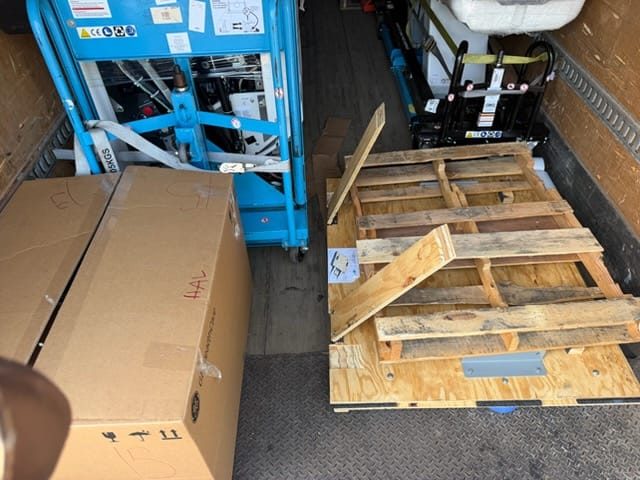
Heavy machinery rides on chains and binders, not straps, tied directly to the same frame holes used for rigging. Federal securement rules generally require the combined working load limit of the tiedowns to reach at least half the cargo weight — on a top-heavy machine, competent carriers go past that minimum. Hardwood dunnage under the frame spreads the load across the deck. Keep every chain off the ram, the cylinders, and any machined surface, and protect the bed and ram faces from road weather — a corroded bed face is a rework bill waiting at the destination.
The move isn't done until it's re-leveled
A press brake bends accurately because its bed is flat, level, and untwisted. Transport, skating, and a new slab all change that. On the other end: set the machine, level along and across the bed with a machinist level to the manufacturer's spec, shim, anchor if the manual calls for it, then let it settle and re-check. Verify ram parallelism and crowning, then run test bends across the full bed length before production parts. If test parts show angle variation end to end, the machine is twisted — and the fix is leveling, not the controller. This is millwright work picking up where the rigging crew's part ends.
Bottom line
- Press brakes are top-heavy by design; tipping, not dropping, is the failure mode to plan against.
- Lock and block the ram, pull the tooling, and rig only from the engineered frame points.
- Loaded height decides how dispatch specs the truck through our licensed broker and carrier partners.
- Chain to the frame over hardwood dunnage; nothing bears on the ram, cylinders, or machined surfaces.
- The move ends at the first good test bend, not at delivery — budget time for leveling and calibration.
Moving a press brake, a fab shop, or a full production line? It's core rigging and millwright work — send the model and both floor layouts.