A hospital equipment move is won or lost on ownership and sequence, not on rigging. Five parties each own a slice — the OEM, biomed, facilities, EHS and infection control, and the rigging crew — and four documents gate the work: decontamination sign-off, an infection control risk assessment, radiation release for imaging, and a booked elevator embargo.
Nothing about a hospital move is hard in isolation. Each individual item has been moved a thousand times before. What makes department relocations go sideways is that five different organizations each own part of the same machine, the building never closes, and one missing signature stops a crew that is already on the clock.
Who owns what in a hospital equipment move?
Write this down before the first shift, because the gaps between these five are where the delays live:
- The OEM or third-party service organization — de-installation, anything that unbolts from the machine itself, reinstallation, calibration and the warranty that depends on both. Their availability, not yours, usually sets the date.
- Biomed / clinical engineering — the asset inventory, what moves versus what retires, tagging, and the functional check that puts a device back in service.
- Facilities — power, chilled water, medical gas, compressed air, network, and having all of it live and inspected at the destination before anything arrives.
- EHS, infection control and the radiation safety officer — the sign-offs. Decontamination, the infection control risk assessment, interim life safety measures, and radiation release on anything in imaging.
- The rigging crew — everything from the moment a component is free and on its own feet to the moment it is set, leveled and anchored on the new floor.
The single most common failure is an item that all five assume belongs to somebody else. A rooftop chiller, a wall-mounted boom, the conduit feeding a cabinet in the next room.
What paperwork gates the move?
Four documents, and none of them can be produced on the night:
- Decontamination sign-off. Anything leaving a clinical area is cleaned and certified clean by the department before a crew touches it. No certificate, no move — and this is the one most often discovered missing at the worst hour.
- Infection control risk assessment. The ICRA sets the barrier class, whether negative air is required, and the exact route the crew walks. It is a permit, not a suggestion, and it shapes the schedule as hard as any dimension.
- Radiation release. For imaging and oncology equipment, a written release from the medical physicist or radiation safety officer. Linear accelerators and anything holding a sealed source have their own, stricter version of this.
- Elevator embargo. Booked in writing, with the hours agreed, the car identified and the department told. Negotiating an elevator at 11pm with a loaded skate in the corridor is not a plan.
Where egress, fire alarm or sprinkler coverage is affected by a barrier or a propped door, interim life safety measures get added to that list.
How do you plan a route through a live hospital?
Walk it with the heaviest and the longest item in mind, not the average one. The questions that matter:
- Which elevator qualifies? Capacity, internal dimensions, door opening and door height. A service car that takes the weight but not the length is no use.
- What is the floor rated for outside the equipment room? Imaging and OR floors are heavy slab. The corridor, the lobby tile and the elevator lobby often are not, and steel plate goes down before anything rolls.
- Does the route cross patient transport? If it does, the hours change.
- Does it ever block an exit? It cannot, at any point, even briefly.
- Where are the pinch points? Door frames, corners, thresholds and expansion joints get protection before the first item moves, not after the first gouge.
Then the access rules: badging, escorts, which doors the crew may use, and where a truck can actually stage without blocking an ambulance bay.
What has to be ready at the destination first?
The receiving room, completely, before anything leaves the old one. That means power terminated and inspected, chilled water and medical gas live and tested, network drops pulled and labeled, floor prepared and anchor locations cored, and the room clean to the standard the department requires.
The temptation on a tight schedule is to move first and finish the destination in parallel. That is how equipment ends up sitting crated in a corridor for a week while an inspection is chased, aging out of its shock-indicator window and blocking the route for everyone else. Sequence the destination ahead of the origin, always.
Which equipment classes cause the most trouble?
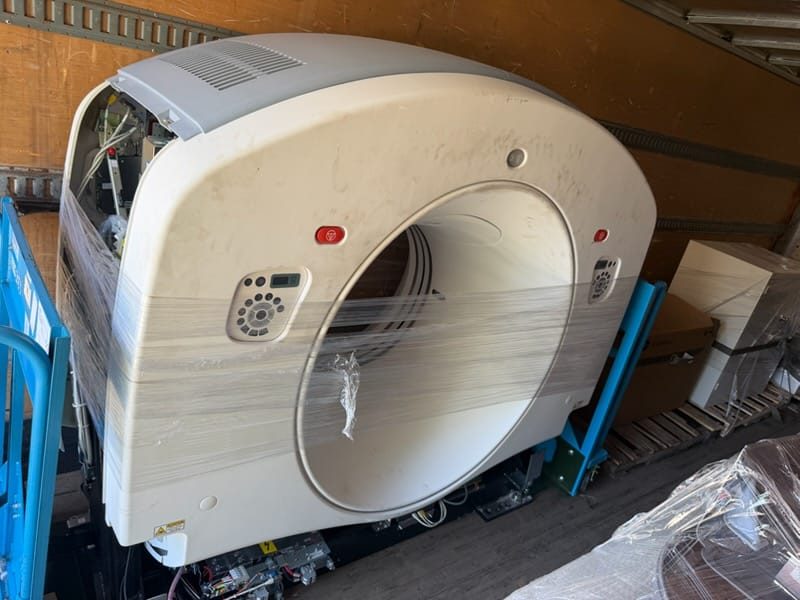
- Imaging. Heavy, anchored, alignment-critical and gated by physics. MRI, CT and fixed x-ray rooms each have their own sequence.
- Sterile processing. Autoclaves and washer-disinfectors are heavy, plumbed, steam-fed and frequently built into the room. Often the single hardest item in a hospital.
- OR booms and lights. Mounted into building structure above the ceiling, not to the ceiling. Structural work, not equipment work.
- Lab and pathology. Analyzers, hoods and freezers — see lab equipment moving for the handling and cold-chain rules.
- Pharmacy. Hoods, refrigerated storage and a chain-of-custody problem that has nothing to do with rigging and everything to do with who signs.
- Beds, carts and furniture. The easy part, and the part that fills the elevator you needed for the analyzer. Schedule it around the hard items.
How is the inventory tracked?
Off biomed's asset list, item by item, scanned out of the old location and into the new one. Every move is also a retirement decision — a meaningful share of what is in the room is at end of life and should be decommissioned rather than carried across, and deciding that in advance shrinks the job. Anything with a cold chain or a calibration interval gets flagged on the same list, because those two categories are what generate the 6am phone calls. On the disposal side the handling is the same discipline as any equipment removal and decommissioning job.
The pre-move checklist
- Ownership matrix agreed in writing across OEM, biomed, facilities, EHS and the rigging crew
- Decontamination certificates issued for everything leaving a clinical area
- ICRA permit issued, barrier class and route defined
- Radiation release in hand for all imaging and oncology equipment
- Elevator embargo booked in writing with hours and car identified
- Destination utilities live, inspected and labeled; anchors cored
- Route walked with the largest item's dimensions, floors plated, pinch points protected
- Asset list reconciled, retirements decided, cold-chain and calibration items flagged
What goes wrong on hospital moves?
The same five things, in roughly this order of frequency. A decontamination certificate that was never issued. A destination room that is not powered or not inspected. An elevator that takes the weight but not the length. An anchored or structurally mounted item — a boom, a rail, a rooftop chiller — that nobody surveyed because it was assumed to belong to another trade. And an ICRA barrier that was never built, discovered by infection control after the crew is already working.
Every one of those is a paperwork or a survey failure, not a rigging failure. That is the whole point: on hospital work, the survey and the sign-offs are the job, and the lifting is the part that goes to plan.
Bottom line
- Five parties own slices of the same move — write the split down before anyone schedules anything.
- Four documents gate the work: decon, ICRA, radiation release, elevator embargo.
- Finish the destination before you empty the origin. Always.
- Walk the route with the largest item, and plate every floor that was not poured for it.
- What fails on hospital moves is paperwork and surveys, not rigging.
Planning a department move, a new tower fit-out, or a single room changeout? It is medical equipment rigging plus the coordination of a full facility relocation. Send the asset list, the floor plans and your downtime window and we will build the sequence — start here.