Tarping a flatbed load means securing the cargo first with blocking, bracing, and tie-downs, then covering it with a tarp sized for the load type — steel, lumber, or hay — anchored corner-first with edge protectors at every sharp point, and a bungee pattern tight enough that wind can't get under an edge. The tarp protects freight from weather; it does not replace the securement underneath it.
Ask a driver who has hand-tarped a hundred loads what the job actually is, and the answer isn't "cover it up." It's securement first, then a cover that survives 600 miles of wind without opening. Most tarping complaints — a torn tarp at a scale, a claim for rust streaks on steel, a DOT stop for a flapping corner — trace back to one of two mistakes: the wrong tarp for the cargo, or a crew that treated tarping as the securement step instead of what comes after it. Fleets that get this right treat tarping as a discipline with its own sequence, its own hardware, and its own failure modes, not an afterthought once the straps are on.
What has to happen before the tarp goes on?
The load has to be fully secured under the same federal cargo securement rules that apply whether it ever gets covered or not — blocking and bracing to stop movement, then tie-downs with a combined working load limit of at least half the cargo weight, before a single tarp corner gets thrown. A tarp is weather protection. It is not rated cargo securement equipment, and treating it as a backstop for straps that weren't tight enough is how a load shifts under the tarp where nobody can see it until the delivery dock.
That means the same securement work covered in blocking, bracing and dunnage happens in full first: cargo blocked against fore-aft and side-to-side movement, dunnage set to keep metal off metal and wood off bare steel, and tie-downs run to the deck's rub rails and stake pockets — never to a tarp strap or bungee point. Once that's done and checked, the tarp goes over a load that's already going nowhere. If the securement isn't sound, fixing it is the job, not a tighter tarp.
How many tie-downs does a flatbed load need?
Two rules run at the same time and the load has to satisfy both. The first is capacity: the aggregate working load limit of everything holding the cargo down has to be at least half the weight of the cargo. The second is count, and it goes by the length and weight of each article rather than by the load as a whole — one tie-down for an article five feet or shorter weighing 1,100 lb or less; two for anything five feet or shorter that weighs more than that, and two for any article over five feet up to ten; then two for the first ten feet plus one more for every additional ten feet or part of ten.
Those are floors, not targets. An article that is not blocked or braced against forward movement needs enough securement to stop it on a hard brake by itself, which is usually more than the minimum count implies. The working load limit that counts is the one stamped on the strap, chain or binder — not its breaking strength, which is a different and much larger number — and a strap with a cut edge, a chain with a stretched link or a binder that will not latch square contributes nothing at all.
The front end matters as much as the count. A headerboard or bulkhead rated for the load, or blocking and bracing that does the same job, is what stops cargo travelling into the cab under braking. Commodity-specific rules apply on top of all of this for coils, pipe, lumber and machinery, and they are stricter than the general rule rather than an alternative to it. None of it changes once a tarp goes on — the tarp adds nothing to the numbers above, and a driver who tightens the tarp because the straps feel light has fixed the wrong thing.
What kind of tarp does the load actually need?
The tarp has to match the cargo's shape and what it needs protected from, because a general-purpose tarp on the wrong freight either tears in the first hundred miles or fails to protect what the shipper is paying to keep dry.
The three tarps that cover most flatbed freight
- Steel tarps — heavy vinyl-coated fabric, usually 18 oz or heavier, built to resist abrasion from sharp edges, coil bands, and banding wire. Steel tarps run smaller and are cut for specific load shapes — coil tarps, flat steel tarps — because steel doesn't flex the way lumber or hay does, and a loose tarp over rigid steel just chafes through at every contact point.
- Lumber tarps — lighter vinyl, typically 14–16 oz, sized in long, wide sheets to run the full length of a stacked lumber or building-materials load. Lumber shifts and settles slightly in transit, so these tarps are cut with extra slack built in rather than pulled bar-tight, and they're usually run in a top-and-side pair rather than one sheet wrapping the whole load.
- Hay tarps / flatbed mesh — a step down in weight and a step up in breathability. Baled hay and similar agricultural freight sheds moisture and needs airflow to avoid mold and heat buildup under a sealed cover, so hay tarps are often a lighter woven or mesh material rather than solid coated vinyl, or a solid tarp run loose enough at the sides to vent.
Using a lumber tarp on a steel load is the most common mismatch a dispatch desk sees repeated: the lighter fabric can't take a coil band or a sharp flange edge and tears out at the first pothole, and the claim that follows blames the driver for a tarp that was never rated for that cargo. Match the tarp class to the freight before the truck leaves the yard, not after a shipper calls about a torn cover.
What's the actual sequence for tarping a flatbed load?
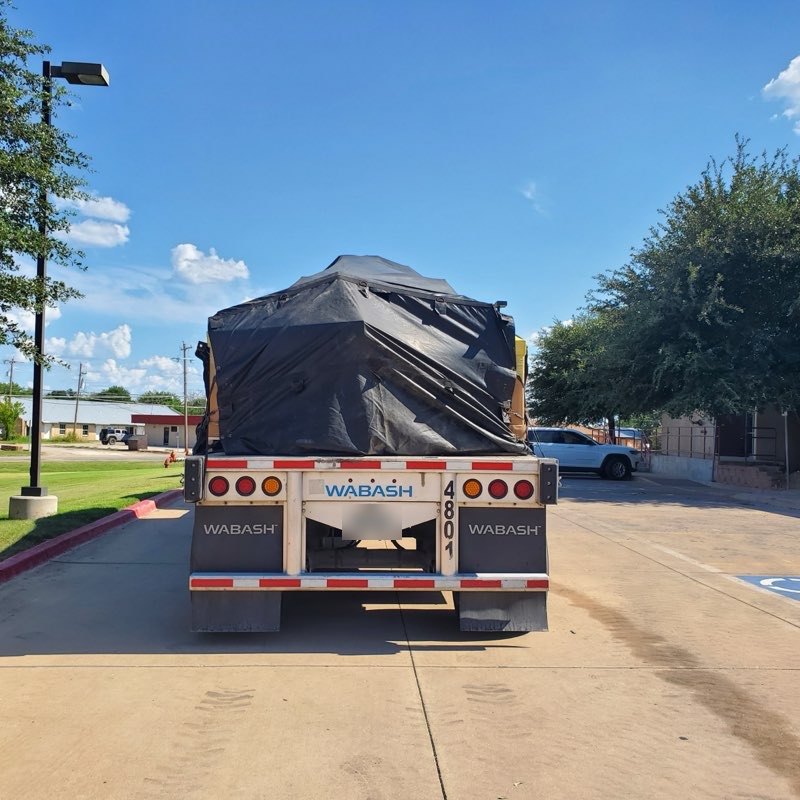
Corners first, then the body of the tarp, then the strap or bungee pattern working from the center out — in that order, every time, because a tarp thrown on loose and adjusted afterward almost always ends up with a gap somewhere wind can find.
- Stage the tarp folded on the ground or on a rack before it goes up, so it deploys in one motion instead of getting dragged across sharp cargo edges while unfolding on top of the load.
- Set edge protectors first at every point the tarp will cross a sharp corner, edge, or protruding fastener — steel angle, plastic corner guards, or old carpet sections on lighter loads. This step happens before the tarp goes over, not after it's already been cut.
- Pull the tarp over from the highest point down, usually starting at the front or the tallest part of the load, so gravity and the crew's pull work together instead of fighting a tarp riding uphill.
- Anchor the four corners first, snug but not final-tight, to hold the tarp in position while the rest of the pattern goes on. A corner that's loose at this stage is a corner that flaps at highway speed.
- Work the bungee or rope pattern from the center toward each end, alternating sides so tension stays even and the tarp doesn't get pulled diagonally off-center.
- Check every edge for a gap a hand can slide under once the pattern is set. Any edge that lifts under a flat hand will lift further at 65 mph.
How should straps and bungees be patterned across a tarped load?
Bungees and rope run at consistent spacing — commonly every 18 to 24 inches along the rub rail — alternating sides as they go, so the tension pulling the tarp down on one side is matched by a hook doing the same job across from it. An uneven pattern, with bungees clustered at one end and stretched thin at the other, is exactly how a tarp starts working loose from the sparse end first.
Hook bungees to the trailer's rub rail, stake pockets, or dedicated tarp D-rings — the same style of fixed hardware used for cargo tie-downs, never to the load itself and never to another bungee as a makeshift extension. A bungee that's stretched past roughly 50% of its relaxed length to reach an anchor point is doing more work than it's rated for and is the piece most likely to snap on a rough stretch of interstate. If the spacing doesn't reach, that's a sign the tarp or the anchor points are wrong for that load, not a problem to solve by overstretching what's already hooked.
On longer loads, a top rope run the full length through tarp grommets — cinched down at intervals, not just at the two ends — keeps the whole cover from ballooning in the middle even when every edge bungee is holding. That center rope is the difference between a tarp that stays flat under wind load and one that fills like a sail between anchor points.
What does wind actually do to a badly tarped load?
It finds the first loose edge and turns it into a lever. A flatbed running 65 mph pushes enough air pressure under a lifted tarp corner to peel the whole cover back within a few miles once it starts — the failure isn't gradual, it's a gap that becomes a flap that becomes a tarp torn loose and dragging, sometimes into the lane behind the trailer. That's a DOT stop at minimum and a struck-vehicle claim at worst, on top of whatever damage the now-uncovered cargo takes in the weather it was supposed to be protected from.
Crosswind on an exposed run — open highway, a bridge deck, a mountain pass — puts more lateral load on a tarp than headwind, because it pushes the tarp sideways against a bungee pattern tensioned for up-and-down movement. That's why the "hand test" at the end of tarping matters more on a route with known crosswind exposure: an edge that seems fine parked in a yard can lift the moment the trailer clears a wind break at highway speed.
What changes about tarping in winter?
Cold-stiffened vinyl cracks instead of flexing, so a tarp that folded easily in July can split at a fold line in January if it's forced into the same tight folds at 10°F. Winter crews work the material more gently — unfolding fully before pulling tight rather than snapping it into place — and inspect tarps coming out of storage for stiffness or crack lines before they go on a load, not after one tears on the highway.
Ice and snow add load weight the tarp has to carry and add a slip hazard for the crew working the deck and the trailer frame while tarping. Bungees also lose some elasticity in deep cold, so a pattern tensioned correctly at 70°F can sit looser at 10°F — a reason to recheck tension on a load that sat overnight in a cold yard before it moves, rather than trusting the tension it was tarped with the day before.
How does a bad tarp job turn into a cargo claim?
Three ways, and all three show up on a delivery report before the driver gets a signature. Moisture intrusion happens where a tarp seam or edge let water track in during transit — claim photos usually show staining that follows a fold line or a bungee gap, evidence an adjuster uses to tie the damage to the tarp job rather than weather generally. Abrasion damage happens where a tarp rubbed against an unprotected edge for the length of the run — scuffed paint, worn coatings, or a hole worn through the fabric at a corner that never got an edge protector. And a torn or lost tarp mid-route is its own claim on top of the freight: replacing the cover, the delay sourcing one, and whatever exposure the load took uncovered in between.
All three are prevented at the same point — the tarping sequence, not the destination inspection. A crew that sets edge protection before the tarp goes on, matches the tarp class to the cargo, and runs an even bungee pattern is the crew whose loads don't generate these claims. A dispatch desk that knows which fleets tarp correctly is booking freight with less claims exposure attached to it, which matters more on repeat lanes than on a single load.
Does tarping change anything about the securement underneath it?
No. The tie-down count and working load limits above are the same whether the load is covered or bare. What tarping adds is a second layer of hardware — bungees, ropes, edge protectors — that has to be inspected alongside the tie-downs at every stop. A loose bungee is visible from the ground in a way a slightly loose chain binder is not, so treat the en-route check as covering both layers, not just the one that is easier to see.
Bottom line
- Tarping comes after securement, never instead of it — blocking, bracing, and tie-downs go on first.
- Steel, lumber, and hay each need a different tarp weight and cut; the wrong tarp for the cargo is the most common cause of a torn cover.
- Corners anchor first, then an even bungee pattern working center-out, then a hand check on every edge before the truck leaves the yard.
- Winter cold stiffens vinyl and slackens bungee tension — recheck a load that sat overnight before it moves.
- Most cargo claims tied to tarping trace back to a skipped step in the sequence, not bad luck on the road.
Running flatbed freight that needs to arrive dry and unmarked? Our truck dispatch desk books loads to fleets running four or more trucks that tarp correctly the first time, matched through our licensed broker and carrier partners — and on freight that runs the same lane week after week, a dedicated lane keeps the same crew and the same tarp routine on it every trip.