Single-source (or turnkey) plant relocation means one contract and one accountable party covers de-install, rigging, transport, and set-and-level at the new site, instead of a facilities team coordinating an OEM, a rigger, a freight broker, and a millwright separately. It genuinely reduces coordination risk on multi-machine, multi-trade moves. On a simple single-machine relocation, it is often just a markup on work one rigging outfit could do directly.
"Single source" and "turnkey" show up in almost every plant relocation proposal, and almost none of them define the term before using it. Buyers search for it because someone used it in a meeting and they need to know what they're actually being sold. The short version: it means one contract, one accountable party, and one schedule covering the whole sequence from de-install to the machine running again — instead of a facilities manager stitching together an OEM technician, a rigging crew, a freight broker, and a millwright as four separate relationships. What follows is what that actually includes, what it costs you to skip it, and the moves where it is genuinely worth paying for versus the ones where it is just a markup on a job one rigger could do directly.
What does "single source" plant relocation actually mean?
It means one contractor holds contractual responsibility for the entire sequence — de-installation, rigging, transport, and set-and-level at the destination — even though several different trades still do the physical work. The OEM still disconnects controls and calibration-sensitive components. The millwright still levels and aligns at the new pad. A rigging crew still lifts and skates. What changes is who is on the hook for the handoffs between them. In a single-source arrangement, the contractor scheduling the truck also knows when the OEM tech is on site and when the new foundation is cured, and builds one sequence around all three. In a multi-vendor arrangement, the facilities team holds that knowledge, because nobody else has visibility across all of it.
"Turnkey" is used almost interchangeably with single-source in this market. Technically turnkey implies a slightly broader scope — sometimes including facility prep, utility hookups, or commissioning support — but in practice, when a contractor's proposal uses either word, ask them to define exactly which of the four stages (de-install, rig, transport, set-and-level) they hold and which they subcontract but still manage. The word alone tells you nothing; the answer to that question does.
What does a single-source contract cover that a multi-vendor arrangement does not?
It covers the seams — the points where responsibility passes from one trade to the next, which is where most relocation delays and damage claims actually originate. A multi-vendor relocation is not missing any of the four capabilities; it is missing one party accountable for the gaps between them. Concretely, a single-source contract typically covers:
- Sequencing the whole job against one restart date. The de-install schedule, the rigging crew's availability, the freight timing, and the millwright's set date are all built backward from when production needs to resume, by one planner who can see all four.
- Asset tracking across the handoff points. A single tag and manifest system follows each machine from the old floor to the new one, rather than the OEM's paperwork, the rigger's bill of lading, and the millwright's install log existing as three disconnected records.
- One point of contact for schedule slippage. If a foundation cure runs long or a machine doesn't fit the planned route, one person owns re-sequencing the rest of the job, instead of a facilities manager calling three vendors separately to find out who can absorb the delay.
- Freight coordinated against the rigging and install windows, not booked in isolation. Movement between sites still runs through our licensed broker and carrier partners, but the truck is scheduled against when the machine is actually rigged and ready and when the destination crew can receive it — not against a generic lead time that ignores both ends.
What it typically does not cover, regardless of how the proposal is worded, is the OEM's own scope on warranty-sensitive equipment. A single-source contractor coordinates the OEM's schedule; it rarely, if ever, replaces the OEM on calibration and controls work, because that scope is usually contractually reserved to the manufacturer or its authorized service organization.
What does coordinating four vendors yourself actually involve?
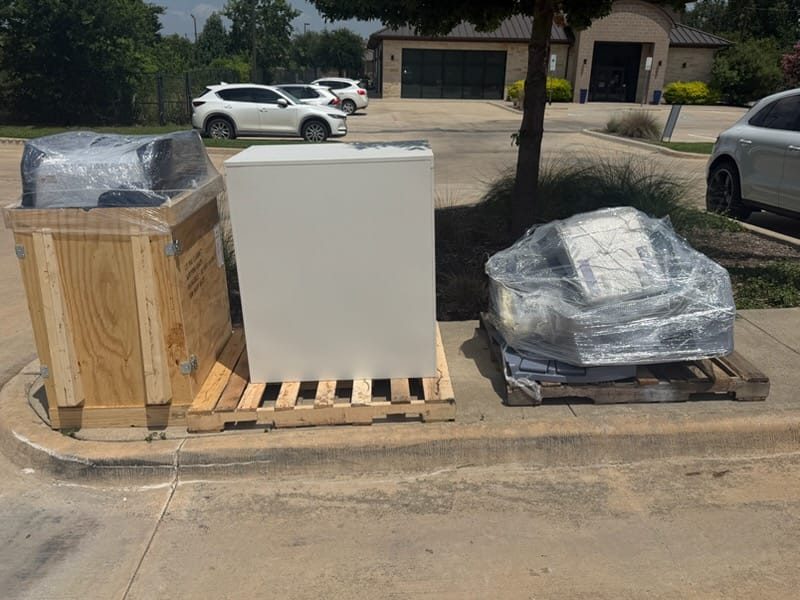
It means the facilities team becomes the sequencing function — the role a single-source contractor would otherwise fill — on top of running the plant. Concretely, that means someone on staff is tracking the OEM's de-install and reconnect windows, confirming the rigging crew's availability lines up with when the OEM has actually finished, booking freight far enough ahead to hit the rigging date without paying for storage if it slips, and coordinating the millwright's set-and-level appointment against the truck's actual delivery, not its scheduled one. None of those four relationships is hard to manage individually. The difficulty is that a delay in any one of them cascades into the other three, and if no single party owns re-sequencing when that happens, the facilities manager becomes the person making four phone calls every time a foundation cure runs a day long or a machine doesn't fit through a doorway as drawn.
This is manageable on a small job. A single-machine reposition with generous downtime tolerance and no calibration-sensitive controls does not need a sequencing specialist — a facilities team that has moved a pump or a compressor before can run those four relationships directly and save the markup. It stops being manageable once the job involves ten or more assets, a hard production restart date, and at least one machine where the OEM's sign-off gates everything downstream. At that scale, the coordination itself is a full-time job for the length of the project, and it is usually invisible until something slips.
Where does single-source relocation genuinely earn its markup?
On multi-asset, multi-trade jobs where a slip in one vendor's schedule would otherwise cascade silently into the other three. The clearest cases:
- Whole-line or whole-plant moves. Forty machines, a hard restart date, and multiple trades touching different assets on overlapping timelines is a sequencing problem before it is a lifting problem. One accountable party who can re-sequence the whole job when one machine runs late is worth real money here, because the alternative is a facilities team discovering the slip after it has already cascaded.
- Anything gated by OEM sign-off. When a machine's rigging can't start until the manufacturer has finished de-installing controls, and the truck can't be booked until rigging finishes, the OEM's schedule effectively controls three other parties' schedules. A single-source contractor watching that dependency in real time catches a slip before it burns a week; a facilities team checking in with each vendor separately usually catches it after.
- Moves crossing a hard downtime window. When the cost of the line being down an extra week dwarfs the coordination markup, paying for one party to hold the sequence is cheap insurance, not overhead.
- Facilities teams without spare planning capacity. A plant that is already running lean on maintenance staff does not have someone to spend eight weeks as a part-time relocation project manager. Buying that role from a contractor is often the actual product being purchased, more than the rigging or the freight.
Where is single-source just a markup?
On a single machine, a short move, or a job with real downtime slack, because there is no meaningful coordination risk to insure against. If one rigging crew is picking one press off a foundation, loading it, and setting it back down at a new site with a loose timeline, there is no sequencing problem to solve — there is one job with a beginning and an end. Paying a premium for "single-source project management" on that scope is paying for a role the job doesn't need. A straight quote from a rigging outfit that also coordinates its own freight through licensed broker and carrier partners covers the same ground without the extra management layer priced in.
The other place it can be a markup rather than a genuine service: when the "single source" is really just a general contractor subcontracting all four stages to the same vendors you could hire directly, with a coordination fee added on top and no real sequencing work happening underneath it. The way to tell the difference is to ask what the contractor is actually doing day to day beyond scheduling — if the honest answer is "passing messages between subcontractors," that's a markup with a title on it, not the sequencing discipline described above.
How do you tell a real single-source contractor from a relabeled subcontractor?
Ask them to describe the sequence for your specific job before you ask for a price. A contractor genuinely running single-source project management can walk through your restart date backward — which machine has to move first because it gates a downstream trade, where the OEM's schedule creates a bottleneck, and what the fallback plan is if a foundation isn't ready on time. A relabeled subcontractor arrangement usually produces a vaguer answer, because nobody has actually built that sequence — they're planning to figure it out as each vendor reports in. The questions worth asking a plant relocation contractor before signing apply directly here; single-source is a structure, not a guarantee of the sequencing discipline that structure is supposed to buy.
Single-source, in short
- One contract, one accountable party, across de-install, rigging, transport, and set-and-level
- The OEM still owns warranty-sensitive de-install and reconnect work regardless of who else is under the contract
- Freight between sites still runs through licensed broker and carrier partners — single-source coordinates that scheduling, it does not replace it
- Worth the markup on multi-asset, multi-trade, hard-deadline moves; often not worth it on a single-machine reposition
- Test it by asking the contractor to sequence your specific job before pricing it, not after
Bottom line
- Single-source and turnkey both mean one accountable party across de-install, rigging, transport, and set-and-level.
- What it actually buys is coordination across the seams between trades — not the trades themselves, which are usually the same people either way.
- It earns its markup on multi-machine moves with a hard restart date or OEM-gated dependencies; it's often overpriced for a single machine with slack in the schedule.
- Ask a prospective single-source contractor to sequence your specific job before pricing it — a vague answer means the coordination isn't real yet.
For how that sequence gets built and held together step by step, see the plant relocation contractor guide. For a full facility move scoped as one project, see plant relocation; for the machinery movement inside it, machinery moving; and for the set-and-level work at the destination, millwright services.