Moving a storage tank starts with rigging it out: a crane pick on lift lugs or trunnions, a spreader bar to keep slings vertical, and tailing to walk a vertical tank upright without buckling the shell. It must be cleaned, purged, and confirmed gas-free first. It moves between sites through our licensed broker and carrier partners, then is set, leveled, and anchored on its ringwall or slab.
A storage tank move is really two rigging jobs bookending a trip — pick it off its old foundation, get it there, and set it on the new one — and most of what decides whether that goes cleanly happens before the tank ever leaves the ground. Here's how a tank actually comes down, moves, and gets set back up.
How do you rig a storage tank for a pick?
The pick starts with the tank's own lift points, not a guess at where the shell looks strong. Most tanks built for relocation carry lift lugs or trunnions welded to the shell at engineered points; if a tank was built to sit in one place forever and never had lugs added, a rigging engineer has to work out a lifting plan before anyone touches a crane hook to it. Those points, and the tank's weight and center of gravity, decide the crane size, the sling angle, and whether one crane can do the pick or the job needs two working in tandem.
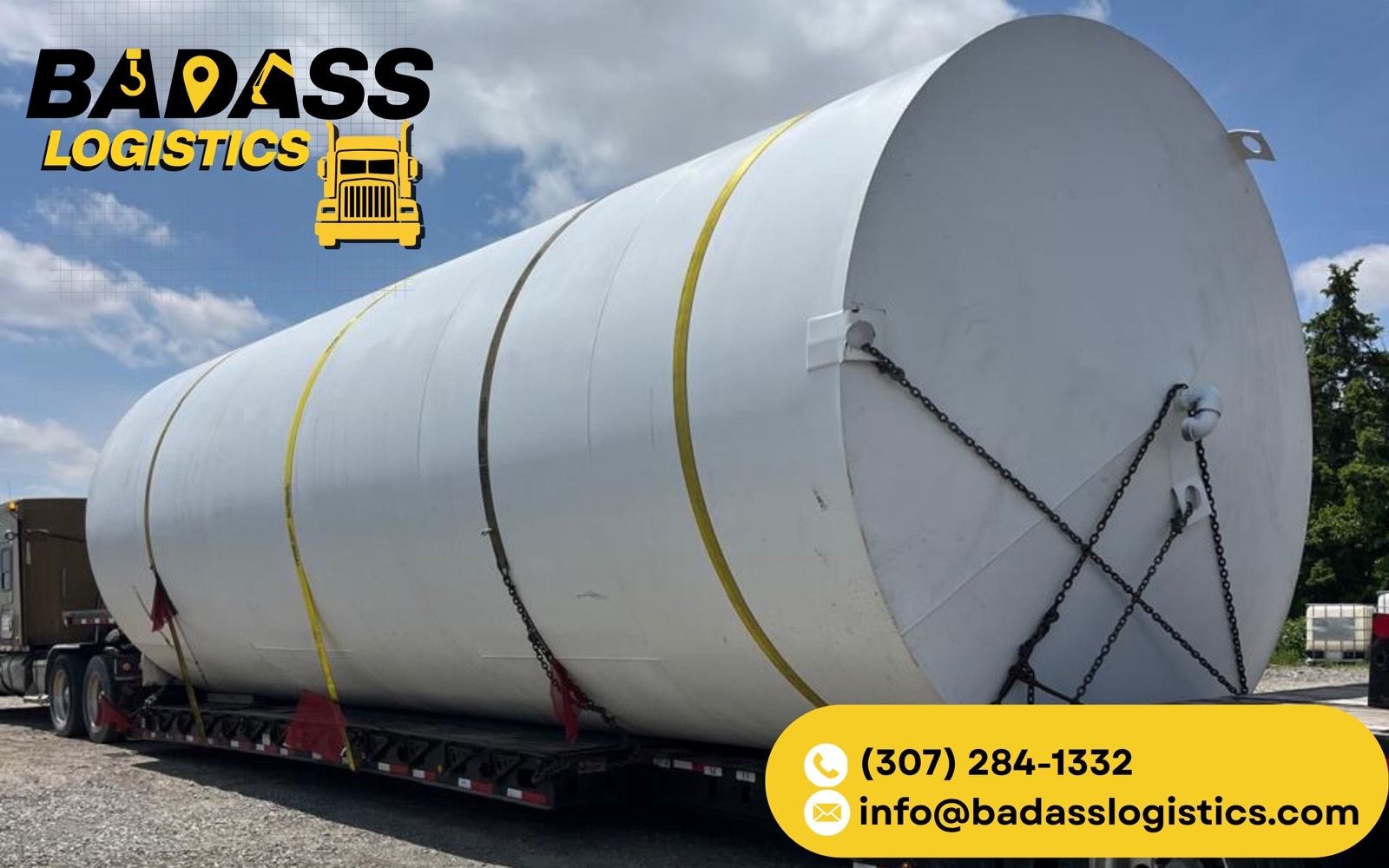
A spreader bar is standard on a tank pick because it holds the slings vertical instead of letting them angle inward toward a center hook, which would otherwise squeeze the shell from both sides like a barrel being cinched. On a tall, thin-walled tank that squeeze can buckle the metal before the tank ever leaves the ground; on a short, heavy-walled horizontal tank the risk is lower but the practice is the same. Rigging at each end of the move is the same discipline as any critical lift — the pick geometry has to match the load, not the other way around.
What does cleaning and purging a tank before a move actually involve?
Any tank that has held product — fuel, chemical, water treatment residue, anything — gets cleaned, ventilated, and confirmed gas-free before a rigging crew rigs it, and before it goes anywhere near a truck. This isn't a formality: vapor left inside a tank is a fire and confined-space hazard for the crew doing the pick, and residue left in the bottom shifts the tank's weight and balance mid-lift in a way the rigging plan didn't account for. A tank that hasn't been through this step is not ready to be rigged, full stop — the schedule waits on the cleaning contractor, not the other way around.
Nozzles, manways, and any instrumentation left on the shell get capped, blanked, or otherwise protected once the tank is empty and clean, both to keep debris and weather out during the move and to keep a protruding fitting from getting caught or bent during the pick and the trip.
How do you tail a vertical tank upright?
A vertical storage tank — the tall, cylindrical kind common in process and water treatment work — usually arrives horizontal on a trailer and has to stand up on its foundation, or it starts upright on an old foundation and has to lie down to travel. Either direction, that transition is handled by tailing: a main crane lifts the top of the tank while a second crane, or a tail beam and winch arrangement, holds and controls the base so the tank rotates through a slow, managed arc instead of swinging or dropping the last few feet upright. A straight vertical pick on a tank that's still lying flat can shock-load the shell at the moment it goes vertical; tailing keeps the load and the geometry under control the entire way through the rotation.
The same crew coordination applies in reverse when a tank in service has to come down for relocation — it gets tailed from vertical to horizontal before it's set on a trailer, cradled the same way it would be for any cylindrical load.
How does a storage tank travel between sites?
Once a tank is down, cleaned, and cradled, it moves between sites through our licensed broker and carrier partners, riding in shaped saddles that match its diameter so the round shell can't roll and isn't taking load on a single point along the way. The trip itself is the least complicated part of the whole job — the pick, the tailing, and the set at the far end are where the engineering and the risk actually live.
How is a storage tank set on a foundation?
A tank foundation is usually a ringwall — a reinforced concrete ring matched to the tank's diameter — or a full slab, and the tank has to land centered on it with the anchor bolt pattern lined up before the crane releases the load. Setting isn't just lowering the tank and walking away: the base gets checked for level across its full diameter, shimmed where the foundation or the tank bottom isn't perfectly flat, and the anchor bolts are torqued to the pattern the foundation was built for. A tank set slightly out of level doesn't fail outright, but it changes how the shell carries load once it's full and can shorten the life of the coating and the foundation seal at the edge.
What a tank relocation plan has to capture
- Tank type, dimensions, wall thickness, and documented lift points or the rigging engineering to establish them
- Cleaning and purge status, with gas-free confirmation before any rigging starts
- Whether the tank needs tailing to change orientation at either end of the move
- Nozzle, manway, and instrumentation locations that need capping or removal before the pick
- New foundation type — ringwall or slab — its anchor bolt pattern, and its level and cure status
- Crane access and ground bearing capacity at both the pick site and the set site
Do nozzles and fittings need special protection during a tank move?
Yes. Nozzles, manways, gauge fittings, and any instrumentation left on a tank's shell stick out past the tank's own profile, and a fitting that gets caught on a rigging sling, a trailer edge, or a doorway during the move can bend, shear, or crack a weld that then has to be repaired before the tank goes back in service. Standard practice is to cap or blank every open nozzle, remove anything that can be removed and ship it separately, and pad or box anything permanently mounted before the tank is rigged. This is the same logic as prepping any piece of equipment for a move — protect what sticks out before it becomes the thing that gets damaged.
Bottom line
- Clean, purge, and confirm gas-free before a tank is rigged — this gates the whole schedule.
- Rig from documented lift lugs or trunnions with a spreader bar to keep slings vertical.
- A vertical tank gets tailed upright or down through a controlled crane rotation, not a straight vertical pick.
- Between sites, the tank travels through our licensed broker and carrier partners, cradled against rolling.
- Setting means centering on the ringwall or slab, checking level, and torquing the anchor pattern.
- Cap or remove nozzles and fittings before the pick — they're the first thing to get damaged in transit.
Relocating a tank or a full vessel yard? Send the tank dimensions, current foundation, and destination foundation and we'll scope the rigging, the tailing, and the set — get a quote.