Before the riggers arrive: verify true weight and shipped dimensions off the data plate, drain the coolant sump, home and mechanically lock every axis, pull tooling and the control pendant, install shipping brackets, grease and wrap the ways and spindle, photograph everything, and clear a measured path to the door.
Most machine moves don't go sideways on the truck. They go sideways in the week before the truck shows up — coolant still in the sump, a toolchanger left loaded, a machine nobody actually weighed. From the dispatch desk, the pattern is consistent: shops that prep load out in a morning; shops that don't burn a full day and sometimes a spindle. Here is the checklist we wish every shop worked through before a machinery move.
Start with the real weight and dimensions
Every downstream decision — trailer type, rigging gear, crew size, loadout method — hangs on two numbers you should nail down first. The legal envelope on US highways is generally 8'6" wide, 13'6" tall, about 53' of trailer length, and 80,000 lbs gross. A machine that pushes the load past any of those thresholds changes the plan: a step-deck instead of a flatbed, or taking the machine down into sections so each piece ships as standard freight. Pull the weight off the data plate or the manufacturer's spec sheet, never from memory. Then measure the machine as it will actually ship — on its skid, with brackets and anything still bolted to it. "Around nine feet tall" is not a dimension. It is a low bridge waiting to happen.
Drain coolant and loose fluids
Standing coolant is the most common prep failure we see. It sloshes, it leaks through door seams onto the trailer deck, and on a tilted machine it finds the electrical cabinet. Pump the sump dry, empty the chip conveyor tray, and pull the chips — wet swarf is dead weight you don't want and a cleanup you really don't want. Hydraulic and lube reservoirs are machine-specific: some manufacturers say drain, some say leave sealed. Check the manual and tell your move coordinator which way you went. Dispose of used coolant per local regulations, not down the floor drain.
Home, retract, and lock every axis
Under power, the servos hold everything where it belongs. On a trailer, nothing holds anything. Send each axis to the position the manual specifies for transport — typically Z fully retracted, the table centered or at a stated coordinate — then lock it mechanically. That means the factory shipping brackets on the spindle head and counterweight if you still have them, or solid wood blocking and steel banding if you don't. Vertical machining centers are the classic failure: an unbraced head walking down its ballscrew across hundreds of miles of expansion joints. If the brackets are long gone, say so up front — a competent rigging crew can block and brace on site, but only if they know before load day.
Strip the loose stuff
Anything that can move, will. Empty the tool carousel and the turret. Remove chuck jaws, vises, tailstock centers, and probes. Dismount the control pendant and any monitor on an articulating arm — pendants shear off in transit, and a replacement is a lead-time problem, not a parts-counter problem. Band or bolt every door, cover, and sheet-metal panel shut; painter's tape is not securement. Bag the hardware, label the bags, and tape them inside the electrical cabinet. If it ships loose, it ships crated — not rattling around inside the enclosure.
Protect the precision surfaces
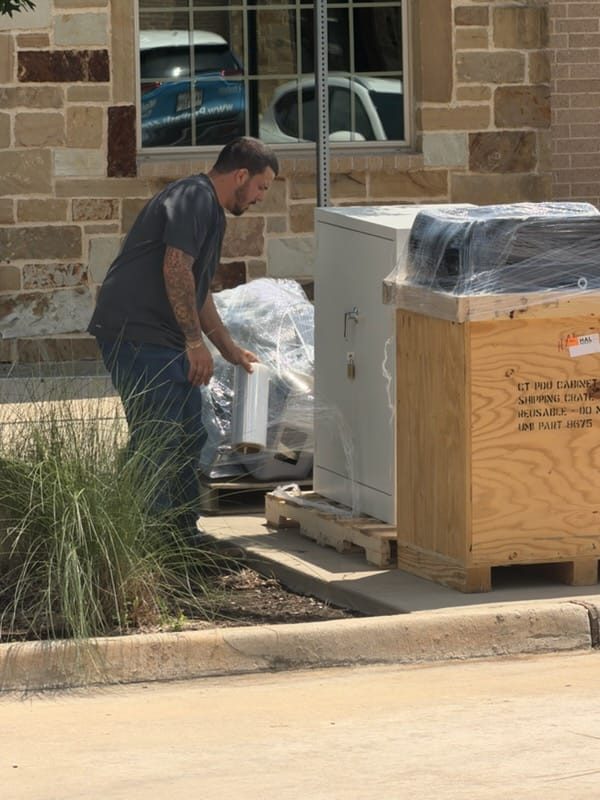
Exposed ways, ballscrews, and the spindle taper are what make the machine worth moving in the first place. Coat exposed way surfaces with way oil or a light grease. Wrap the spindle nose and put a plug or a covered tool in the taper. If the machine rides an open deck, settle the shrink-wrap and tarping plan with the movers before load day — road film and rain on bare cast iron is corrosion, and corrosion on a way surface is a rebuild conversation. This matters double for CNC equipment, where thousandths are the product.
Photograph everything
Before anyone touches the machine, shoot it: all four sides, the data plate, the control screen showing hours, every existing ding, close-ups of the ways and spindle. Two minutes with a phone establishes condition at pickup and ends every condition argument at delivery before it starts. Shoot again after prep, with brackets and banding visible, so the receiving end knows exactly what to remove and where.
Clear the path out
The crew can move the machine; they cannot move your building. Measure every doorway, dock, and aisle against the shipped dimensions — height on the skid included. Confirm the floor along the route takes the point loads of machine skates under full weight. Clear the aisle of pallets, benches, and product the day before, not while the crew stands there. If the machine has to come out through a wall panel or over a dock edge at an angle, that is planning, not improvisation — flag it when you request a quote, and read how to move a CNC machine for what happens on the rigging side once your prep is done.
Bottom line
- Verified weight and shipped dimensions drive the trailer, the rigging plan, and the loadout — pull them from the data plate and a tape measure, not memory.
- Drain the coolant, lock every axis, and bracket the spindle head. Transport vibration destroys anything left free to move.
- Pendant off, tooling out, doors banded, photos of everything — before the crew arrives, not after.
- Missing shipping brackets and tight exit paths are solvable, but only if the movers know before load day.