Moving a packaging or bottling line means treating the filler, capper, labeller, and connecting conveyors as one sequenced project, not separate machine moves. Teardown runs in reverse process order, change parts get tagged to survive re-timing, and sanitary lines get drained to food-grade standard first. Reinstall sets the filler as the anchor, re-times the rest of the line to it, and runs the line empty before product goes through it.
Ask a plant manager what's moving and they'll say "the packaging line." Ask a rigging crew what that means and the answer is a filler, a capper, a labeller, a case packer, a palletizer, and several short conveyor sections stitching them together — each a separate machine, often from a separate OEM, bolted to its own footprint. Move any one like a standalone piece of equipment and it will rig out fine. The line will not run when it lands, because a packaging line's real product isn't any single machine's output — it's the timing between them, and timing is the first thing lost when six machines get treated as six unrelated jobs.
The fix isn't more caution on any one machine. It's sequencing the whole line as one project with one plan — the same discipline used on any multi-machine plant relocation, applied at line scale instead of floor scale.
Why can't each machine on the line just move separately?
Because nothing on a packaging line runs to its own clock — every machine is paced by the ones next to it, and that relationship breaks first when the line is moved machine-by-machine with no shared sequence. A filler's output rate, a capper's chuck spacing, a labeller's web speed, and the change parts specific to one bottle or pack size are all set relative to each other, usually by cam timing that took a commissioning tech days to dial in the first time. Rig the filler out on Tuesday with one crew and the capper out on Thursday with a different crew, with no shared asset list and no shared timing record, and the two machines arrive at the new site as well-moved boxes with no record of how they used to talk to each other.
The other reason is the conveyors between the machines. They are usually the shortest, cheapest-looking items on the line and the ones most often left off the plan. A packaging line without its transfer, accumulation, and infeed/outfeed conveyors sequenced with the machines on either end doesn't reconnect — it just has gaps. Moving the conveyor sections themselves is its own piece of work; on a packaging line, what matters more than any single conveyor's rigging is that it lands on the plan as a numbered item between two machines, not an afterthought once both machines are already set.
What order do the machines come off the line?
Reverse process order, so the line is dismantled from the downstream end back to the infeed. A typical line runs filler, capper or seamer, labeller, coder, case packer, then palletizer, with conveyors between each. Teardown goes palletizer first, then case packer, labeller, capper, and filler last — because the filler is both the most sensitive machine on the line and the one everything else is timed against, so it gets the most careful handling on both ends of the move.
Before anything is unbolted, every machine gets a fixed position in a written sequence with its own number, not just a name on a list. That sequence is what turns "the packaging line move" from one large ambiguous job into specific, bounded ones:
- Asset list with change parts tagged to the machine they belong to. Star wheels, guide rails, filling heads, capper chucks, and labeller mandrels are usually sized to one product and get lost or mixed up faster than the machines themselves. Bag, tag, and photograph every set before it leaves the floor.
- Timing and setpoint records pulled before disconnect. Cam positions, servo offsets, and PLC recipe files get exported and saved off-machine. A packaging line's control system usually holds this data; getting it out before power is cut is far cheaper than a controls tech rebuilding it from scratch at the new site.
- Utility drops mapped per machine. Compressed air, vacuum, hot glue, CO2 or nitrogen dosing, wash-down water, and drains all terminate at specific machines, and a licensed electrician and plant utilities crew disconnect them in the same sequence the machines come off.
- Photographs of every guard, interlock, and safety switch position before disassembly — a missed interlock is the kind of thing that stops a commissioning sign-off cold.
What do sanitary and food-grade lines need that a dry-goods line doesn't?
Anything that has touched product needs to be cleaned, drained, and protected to food-grade standards before it travels — not just switched off. A bottling or filling line carries wash-down surfaces, CIP (clean-in-place) piping, stainless product-contact parts, and seals and gaskets that are food-safe by spec. None of that survives casual handling the way a dry conveyor frame does.
- Full CIP or manual clean-out before teardown. Product residue left in a filler bowl, hose, or valve body is a contamination risk on reinstall and, left long enough in transit, a corrosion and odor problem. This is plant sanitation's scope, finished and signed off before the crew starts disconnecting.
- Drain and purge every wetted line. Product feed lines, CIP supply and return, and any pneumatic lines that pass near product contact get blown dry. Standing liquid in a line that then sits in an unheated trailer is a freeze risk in winter and a bacterial growth risk any time of year.
- Protect product-contact surfaces during transit, not just the machine frame. Stainless bowls, filling nozzles, and capper chucks get wrapped and capped, not just draped with a tarp over the whole machine. A scratched product-contact surface can fail a sanitary inspection even if the machine runs fine mechanically.
- Keep gaskets and elastomer seals labelled to their machine and, ideally, replaced on reinstall. Food-grade gaskets are cheap compared to the downtime of finding out on the first production run that one degraded in transit and the fill head is weeping.
None of this changes how the machines get lifted or skated — that part is ordinary machinery moving work. What changes is everything upstream and downstream of the lift: who signs off that a vessel is clean, and what condition a surface has to be in before it's wrapped and loaded.
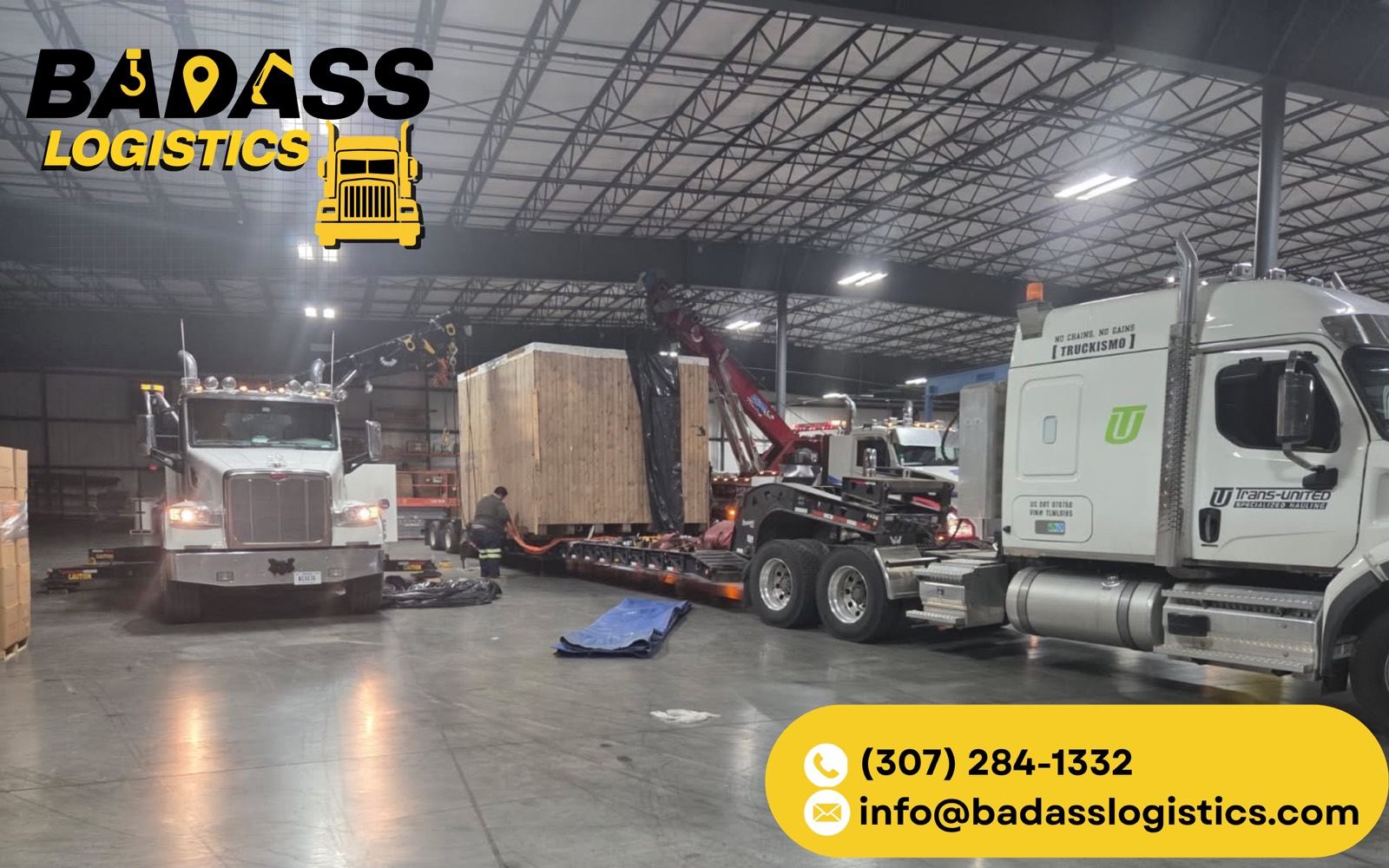
How is a packaging line rigged and loaded for transport?
Each machine on its own skid or base, blocked and braced individually, but loaded and manifested as one line rather than six unrelated shipments. Most filling, capping, and labelling machines are light enough relative to their footprint that the rigging is straightforward — toe jacks, machinery skates, and a level path out of the building, the same jacking and skidding approach used on any mid-weight production machine. The harder part is protecting what sticks out: guide rails, star wheels, sensor arms, and change-part turrets are often the most fragile and expensive components on the machine, and they get removed, individually padded, and crated separately rather than left bolted on.
Conveyor sections between machines get broken down at their joints, frames and belts kept together and tagged to their position number, not just labelled "conveyor." Loading order on the trailer should mirror unloading order at the destination, so the crew at the new site isn't digging through the trailer to find the filler because it shipped first and got buried. Movement between sites runs through our licensed broker and carrier partners, with the whole line's manifest — every machine, every crate of change parts, every tagged conveyor section — traveling as one shipment record.
What the line survey has to capture
- The full machine sequence with model, weight, and footprint for each, filler through palletizer
- Conveyor sections between machines, numbered to their position in the line
- Change parts and product-contact components tagged to the exact machine and product they belong to
- Timing, cam, and PLC recipe data exported before disconnect
- Utility drops per machine — air, vacuum, CO2/N2, wash-down water, drains — and who disconnects each
- Floor plan and utility layout at the destination, confirmed before the first machine leaves
- Which machines need OEM or controls techs present for de-install, reinstall, or both
What order does the line go back together in?
Forward process order, with the filler set and leveled first as the anchor the rest of the line gets timed against. Infeed conveyor, filler, capper or seamer, labeller, coder, outfeed and accumulation conveyor, case packer, palletizer — each machine lands, gets leveled and anchored where its footprint calls for it, and gets its utilities reconnected before the next machine in the sequence is even unloaded, so the crew isn't tripping over half-connected equipment. This is millwright work as much as rigging: leveling each base to spec, then aligning each machine to its neighbors so product paths and change parts line up across the joins.
Once every machine is set, the line gets re-timed — cam positions and servo offsets restored from records pulled before teardown, guide rails and star wheels reinstalled to the tagged product size, interlocks and guards reconnected exactly as photographed. The line then runs empty, without product, through a full mechanical cycle to confirm timing and clearances before anyone risks product on it. Only after an empty run comes back clean does product go through for a real commissioning run, checked against the same output rate and reject rate the line held at the old site. A line that "moves fine" mechanically but jams at the capper or misses labels at speed almost always traces back to one skipped step here — the timing data wasn't captured, or the empty run got skipped to save a day.
Who needs to be on site for the move, beyond the rigging crew?
Plant sanitation to clear and sign off the CIP work, a controls tech to pull and restore timing data, a licensed electrician for utility disconnects and reconnects, and — for any machine under warranty or with proprietary change-part geometry — an OEM technician for the final commissioning check. The rigging crew's job is the physical move: teardown sequence, protection, transport, and reset. It is not a substitute for the process expertise that makes the line produce good product again, and a plan that leaves out any of those roles tends to surface the gap during commissioning, when it's most expensive to fix.
For a whole packaging or bottling line, this is exactly the coordination problem covered in what single-source plant relocation actually buys you — a multi-machine, multi-trade move with a hard restart date is the case where one party sequencing the whole job earns its keep, rather than a facilities team discovering a missed handoff after the line is already down.
What goes wrong most often on a packaging line move?
Four things, almost always in this order. Change parts and product-contact components get bagged generically instead of tagged to their exact machine and product, so reinstall turns into a matching exercise nobody has time for. Timing and PLC recipe data doesn't get pulled before disconnect, because it looks like software work rather than moving work. Conveyors between machines get treated as filler items instead of numbered positions in the sequence, so they arrive last and hold up the reinstall. And the empty run before product gets skipped to save a day, which is the fastest way to find a timing problem on a customer's order instead of on the floor.
Bottom line
- Sequence the whole line as one project — teardown in reverse process order, reinstall in forward order, filler as the anchor.
- Tag change parts and product-contact components to the exact machine and product before anything is bagged.
- Pull timing, cam, and PLC recipe data before disconnect. It's the fastest thing to lose and the slowest to rebuild.
- Sanitary lines get a full clean-out and drain to food-grade standard before teardown, not just a power-down.
- Run the line empty before product goes through it at the new site.
Moving a filling line, a bottling line, or a full packaging cell is machinery moving and plant relocation work run together — the machines and the sequence between them. Send the line's asset list, the change-part inventory, and the target restart date and we'll build the sequence around it — start here.