Rig a lathe from the bed casting or factory lift points — never the ways, leadscrew, or feed rod. Pull the chuck, tailstock, and steady rests, lock the carriage at the headstock, skate on three points of support, ship precision machines air-ride, and re-level both ends of the bed to matching readings before the first cut.
A lathe is one long precision casting with everything else bolted to it. Every cut the machine will ever make rides on the geometry ground into that bed at the factory. Twist it during a move — wrong lift point, uneven skating, a hard set-down — and the machine turns a taper into every part until somebody re-levels it. Here is how our machinery moving crews handle them: nothing touches the ways from door to door.
Know what you are moving
"Metal lathe" covers a huge range. A 12x36 bench machine weighs a few hundred pounds. A 14x40 engine lathe typically runs 2,000 to 3,000 pounds. A Monarch 10EE toolroom lathe packs over 3,000 pounds into the footprint of a desk, and turret lathes and hollow-spindle oilfield machines run 10,000 to 20,000 pounds and beyond. Pull the builder's plate and manual before anyone touches the machine. Nearly every lathe rides legal — inside 8'6" wide, 13'6" tall, and 80,000 pounds gross — so the problem is rarely the truck. It is geometry.
One number matters more than gross weight: headstock bias. The headstock — spindle, gearbox, motor — puts well over half the weight at one end. The center of gravity is nowhere near the middle of the bed, and every lift, skate, and tie-down decision starts there.
Rig from the casting, never the ways
The ways are the finished surfaces the carriage and tailstock ride on. Nothing bears on them. No slings, no forks, no chains, no boots. Same rule for the leadscrew, feed rod, and control rod running along the front of the bed — a forklift coming in from the operator side will bend all three before the driver feels a thing.
- Slings: around the bed casting between headstock and carriage and near the tailstock end, with hardwood softeners, run to a spreader bar so they pull vertical instead of pinching the ways.
- Forklift: padded forks under the bed or base webs from the back or the tailstock end, load centered on the headstock bias — not the middle of the bed.
- Factory points: many lathes have cast lifting bosses or threaded lift holes. If the manual shows them, use them.
Strip it before it rolls
Chuck: comes off. A large four-jaw hangs serious weight cantilevered off the spindle nose, and every pothole hammers that leverage into the spindle bearings. On a threaded nose it can also unscrew itself in transit. It rides in its own crate.
Tailstock: remove and crate it, or lock it down hard at the far end of the bed and strap it. A loose tailstock is a battering ram on rails.
Steady rests and follow rests: off, wrapped, crated. Carriage: run it up tight to the headstock, lock it, strap it — rolling mass over the center of gravity, not loose at mid-bed.
Then coat the ways in way oil or rust preventive and wrap the machine. Bare cast iron flash-rusts in one humid night on the road.
Skate on three points, not four
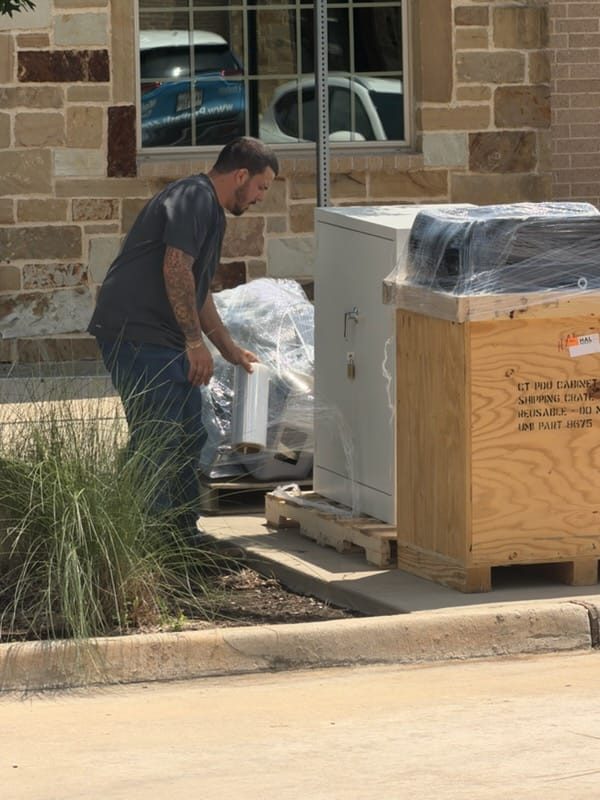
Machinery skates get the lathe to the door, and this is where beds get twisted. Three points of support cannot rock: two skates under the headstock end, one steerable skate under the tailstock. Four skates on a floor that is not dead flat means the bed spends part of the trip bridging a diagonal — twist, applied under full machine weight. Toe-jack under the casting, lift only as high as the skates need, sweep the route, walk it slow.
Air-ride van or flatbed
A toolroom or CNC-grade lathe wants an air-ride trailer — the suspension soaks up the shock loads a stiff-sprung deck passes straight into the spindle bearings and ways. A rough heavy engine lathe travels fine on a flatbed or step deck with solid blocking, chained through the base or foot holes — never over the bed, never near the leadscrew. Shrink wrap under a tarp keeps road spray off the machined surfaces either way. The same discipline applies to machining centers — see how to move a CNC machine.
How do you level a lathe after a move?
Setting the lathe on the new floor is not the end of the job — it is the starting point for leveling, and leveling is what actually finishes the move. The bed has to come back to the geometry it had on the factory floor before it is allowed to turn a part.
Put the level on the ways, not the sheet metal. Set a precision machinist level on a machined reference surface along the ways at the headstock end and read it, then slide it to the tailstock end and read it again. Confirm the sensitivity you need and the target tolerance against the builder's installation manual rather than a generic number — specs vary by model and swing. Matching lengthwise readings at both ends is the first checkpoint, not the finish line.
Check across the bed, not just along it. A lengthwise reading can look clean while the bed is still twisted side to side. Turn the level 90 degrees and check crosswise at the headstock end, then crosswise again at the tailstock end. A difference between those two crosswise readings is twist, even when the lengthwise numbers already agree — that cross check is what actually confirms the bed is flat.
Adjust at the leveling screws or pads, one point at a time. Most lathes sit on built-in leveling screws threaded through the base or feet, bearing on steel pads or shims — follow whatever support the builder's manual specifies rather than reusing whatever the machine sat on at the old plant. Work the screws under the headstock end first since that end carries the weight, then the tailstock end, re-reading the level after every adjustment. Moving one screw shifts the reading at the others, so this is a loop, not a single pass.
Recheck once the floor and the machine settle. A slab compresses under a new point load, and leveling screws can creep slightly once the machine runs its first jobs. Recheck the level after a week or two of use, and again if the shop goes through a big seasonal temperature swing — a twist that was not there on install day can show up once the floor and the casting both finish moving.
Confirm with a cut, not just a bubble. A level reading zero is a precondition, not proof. Turn a test bar between centers and mic both ends for taper; face a disc and check it for flatness if the work calls for it. The lathe is level when the part says so.
A millwright or OEM service tech typically owns this step — see our millwright services page for how that trade fits into a machine move, or the full procedure in our machine leveling and alignment guide. Get a quote and we can coordinate the rigging and the leveling on one schedule.
Bottom line
- Nothing touches the ways, the leadscrew, or the feed rod — rig from the bed casting or the factory lift points.
- Chuck, tailstock, steady rests: off the machine and crated. Carriage locked tight against the headstock.
- The headstock carries well over half the weight — plan every lift, skate, and chain around that bias.
- Three points of support beat four on any floor that is not dead flat.
- The move is done when a machinist level reads the same at both ends of the bed and a test cut runs true.