Moving a lab freezer is a cold-chain problem before it is a rigging problem: the constraint is how many hours the contents can survive off power, not the cabinet weight. Transfer irreplaceable samples to backup cold storage or dry ice ahead of the move, keep the unit upright to protect the compressor oil charge, and let it settle before restart. Validate temperature recovery before anything goes back in.
A lab freezer move gets planned like an appliance delivery and runs like a chain-of-custody event. The cabinet itself is not hard to rig — most upright ultra-low units are a four-hundred to nine-hundred pound box on wheels or a pallet base, and getting one through a doorway is ordinary work. What makes these moves go wrong is that everybody plans the rigging and nobody plans the clock. From the moment a -80°C freezer loses power, its contents are warming, and the entire job exists to manage that fact.
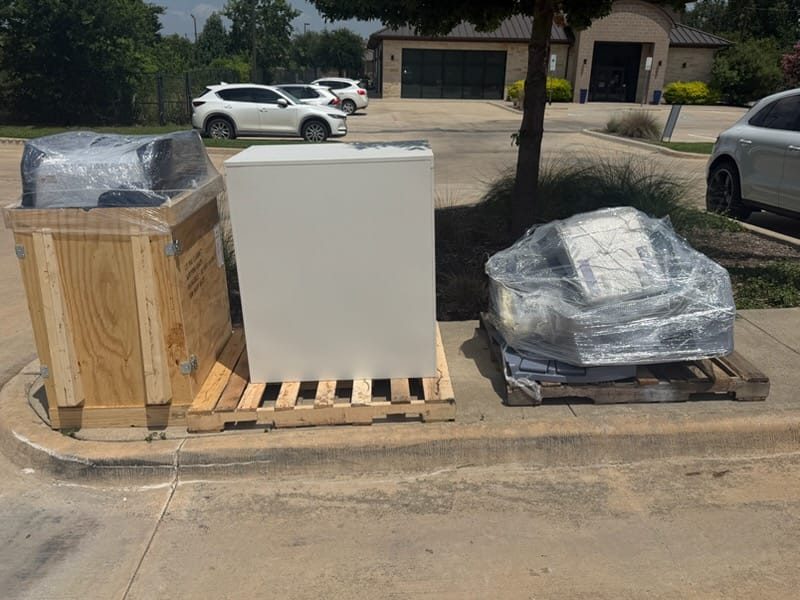
What's the hardest part of moving a lab freezer?
Keeping the contents inside the survivable temperature window while the cabinet itself is offline, in transit, and settling back in at the new site. A -80°C ultra-low freezer (ULT) is not a household appliance running a single compressor — most use a cascade refrigeration system, two independent circuits staged in series to reach that temperature, and that system cannot be treated casually in transport or on restart. But the refrigeration hardware survives a move that's planned around it. Cell lines, tissue banks, plasma, and reagent libraries do not survive a plan that treats the freezer like a shipping crate. The rigging crew's job is to get the box from point A to point B without tipping it, shocking it, or leaving it off power longer than the plan allows. The lab's job is to decide, in advance, what happens to what's inside while that's happening.
How long can a -80 freezer stay off before samples are at risk?
Less time than most people assume, and it depends entirely on how full the freezer is. A fully loaded ULT freezer has enormous thermal mass — the boxes, racks, and frozen contents hold cold the way a full chest freezer holds cold far longer than an empty one. Manufacturers generally rate a full, undisturbed unit at somewhere in the range of four to twenty-four hours before the core temperature climbs out of a safe band, door closed the entire time. A half-empty unit, or one where the door gets opened repeatedly during packing, loses that buffer fast. There is no single number that applies to every model and every load — the manufacturer's own hold-time data for that specific freezer, at that specific fill level, is the number to plan against, not a rule of thumb from a different lab.
That buffer is also a one-time asset. It gets spent the moment the freezer is unplugged, and it does not reset. If the door was opened at any point to check on the load, or the unit sat in a warm loading dock or a truck without climate control, the real remaining time is shorter than the spec sheet says. Plan the move to consume less than the buffer, not right up against it.
Should you defrost the freezer or move it cold?
Almost always, move it cold — but only after the samples themselves have been dealt with separately. "Cold move" doesn't mean the freezer stays running during transport; it means the cabinet is powered down for the shortest possible window and reaches the new site before its internal thermal mass has had time to climb, so restart is fast and uneventful. A full defrost — letting the unit come completely up to ambient before the move — is sometimes the right call, but only when the freezer is being decommissioned, replaced, or is confirmed fully empty. Defrosting a loaded freezer is not a relocation method; it's how a biobank gets destroyed.
The decision that actually matters happens before either of those: what happens to the samples. Three options, roughly in order of how much they cost and how much risk they remove:
- Transfer to a second freezer at the destination first, then move the empty cabinet. The cleanest option when a receiving unit is already in place and qualified. No cold-chain window to manage at all for the inventory — only for the empty box.
- Pack into dry ice or a portable backup unit for the duration of transport. The standard approach when there's no second freezer waiting. Dry ice holds roughly -78°C and, packed correctly with the freezer's own racks and boxes for insulation, can cover several hours to a day depending on density and ambient temperature.
- Move the loaded freezer cold, unpowered, banking on its own thermal mass. The riskiest of the three and only defensible when the trip is short, the load is dense, and the freezer's specific hold-time data supports it with margin. This is not the default plan — it's the fallback when the other two aren't available.
Irreplaceable or research-critical samples — patient specimens, unique cell lines, anything without a source to re-order from — should never ride on the "it'll probably hold" math. They travel separately, in a qualified backup, on a documented schedule, before the empty freezer gets touched by anyone with a hand truck.
What's the backup plan if something goes wrong mid-move?
A named backup freezer, a temperature logger running continuously, and a person who owns the decision to abort. Every lab freezer relocation needs a fallback that doesn't depend on the move going exactly as scheduled — a second ULT unit at the origin or destination with open capacity, a liquid nitrogen dry shipper for the highest-priority samples, or at minimum a portable backup unit with independent power on-site for the transfer window. Continuous temperature logging — a data logger placed with the samples, not just relying on the freezer's own display — is what turns "we think it stayed cold" into a documented fact if a funder, an IRB, or a lab director asks later. And someone needs the authority to stop the move and re-route samples to the backup if the schedule slips, before the theoretical hold-time gets tested for real.
Why does the compressor care how the freezer is handled in transit?
Because a cascade refrigeration system runs on a fixed oil charge that circulates with the refrigerant, and tipping or jarring the unit can send that oil somewhere it doesn't belong. Compressor lubricating oil migrates through the refrigerant lines during normal operation and returns to the compressor sump when the unit is upright and running. Lay the cabinet on its side, tip it past the angle in the manufacturer's manual — commonly no more than 45 degrees from vertical, though the exact figure varies by model — or subject it to hard shock, and oil can pool in the coils or the low-stage circuit instead of the compressor. Power it up in that state and the compressor can run dry or slug on liquid refrigerant, either of which damages it, sometimes permanently, on the very first startup after the move.
The fix is procedural: keep the freezer upright through the entire move, transport it on air-ride to cut vibration and shock, and if it was tipped or jostled beyond tolerance, let it stand and settle — typically several hours to a full day, per the manufacturer's guidance — before restarting. Powering up immediately after rough transport is the single most common cause of a freezer arriving intact and failing its compressor in the first week.
How does the rigging itself actually work?
Low and slow, upright, on a machinery dolly or pallet jack rather than a standard appliance hand truck for anything in the heavier upright class. The path out of the building gets walked before the day of the move, the same as any lab equipment move: door widths and thresholds, corridor turns, elevator interior dimensions and rated capacity, and floor loading anywhere the path leaves a slab built for the equipment room. A loaded ULT freezer is heavy enough, and awkward enough in its footprint, that a corner miscalculated on paper becomes a wall gouge or a tipped unit in person. Once it's on the truck, it rides enclosed and air-ride, blocked and braced so it cannot shift or tip in transit — the same shipping standard used for imaging systems and other alignment-sensitive lab and hospital equipment. Transport between sites moves through our licensed broker and carrier partners.
What to lock down before the freezer is unplugged
- That model's manufacturer-rated hold time at its actual fill level — not a generic estimate
- A destination or backup freezer confirmed empty, powered, and at temperature before transfer starts
- Dry ice, LN2 dry shipper, or portable backup unit staged and ready if no second freezer is available
- A continuous data logger placed with the samples, independent of the freezer's own display
- Door widths, corridor turns, elevator capacity and floor loading walked on the actual route
- The manufacturer's maximum tilt angle and required upright settling time before restart
- A named person with authority to abort or re-route samples if the schedule slips
How do you maintain chain of custody during the move?
The same discipline a biobank or pathology lab already applies to sample handling, extended to cover the relocation itself. Every box and rack gets inventoried and scanned against the lab's asset or sample list before it leaves the old freezer, not after it arrives at the new one — a discrepancy discovered in transit is a much smaller problem than one discovered a week later. Temperature logs from the move travel with the documentation, not just in a drawer, because a regulated lab's quality system will ask for them. And whoever physically has custody of the samples at each handoff — lab staff, rigging crew, courier — is recorded, the same way any other regulated cold-chain shipment tracks custody. None of that is rigging work. It's the paperwork that makes the rigging work defensible afterward.
How long after the move before the freezer is back in service?
Plan for the pull-down time to reach set point, then a stabilization period before anything critical goes back in — figures that come from the manufacturer's own documentation for that model, not a guess. A -80°C cascade system pulling down from ambient after transport and settling time takes measurably longer than one that was simply unplugged and replugged in place, because the compressor oil has to fully redistribute and the cabinet has to work through its full temperature range rather than a small excursion. Most labs treat this as a mini-requalification: verify the display against an independent calibrated probe, confirm the alarm system trips correctly at the door open and high-temperature thresholds, and log a stable run at set point before loading the first sample back in. Regulated labs — GLP, GMP, CAP-accredited — typically fold this into a documented requalification, sometimes a light version of the original installation and operational qualification the unit went through when it was first commissioned. Skipping that step to get the freezer back in service faster is how a freezer that looks fine on the display ends up with an undetected temperature excursion nobody logged.
Bottom line
- The constraint is time off power, not weight — plan against that model's actual rated hold time at its real fill level.
- Move the samples separately whenever possible: to a backup freezer, dry ice, or an LN2 dry shipper, before the empty cabinet moves.
- Keep the unit upright through the whole move and let it settle before restart — a cascade compressor can fail on the first startup after rough handling.
- A continuous data logger with the samples, not just the freezer's own display, is what proves the cold chain held.
- Validate temperature recovery and alarm function before the first sample goes back in — don't skip the requalification to save a day.
Relocating a ULT freezer, a biobank, or a pathology lab as part of a larger move? This is lab equipment moving work, and where the freezer sits alongside imaging or diagnostic systems it overlaps with medical equipment rigging. Send the model, the fill level, and the route out of the building and we'll build the sequence around the samples — start here. For the department-level picture, see the hospital equipment relocation guide and what it costs to move medical equipment generally.