A load is oversize when it exceeds 8'6" in width, 13'6" in height (14' in most western states), or legal trailer length — and overweight when it exceeds 80,000 lbs gross or federal axle limits. Anything past those numbers needs a permit from every state it crosses.
A load is oversize the moment it exceeds any one of these limits: 8 feet 6 inches (8'6") wide, 13'6" tall in most states (14' across most of the West), or the legal trailer length on its route. It is overweight above 80,000 pounds gross — or sooner, if too much of that weight sits on one axle group. Cross one line and you need a state permit. Cross several and you're into escorts, route surveys, and travel-time restrictions. Here is where every threshold sits.
Width: 8'6" Is the Line in All 50 States
Width is the most common trigger and the most uniform. Federal rule caps legal width at 8'6" (102 inches) on the Interstate and National Network, and every state runs the same number. At 8'7" you are oversize — no rounding, no grace inch. Machinery is the usual offender: mid-size excavators, dozers with the blade on, and prefab skids routinely land between 9 and 12 feet. Basic single-trip permits usually cover that range; go wider and pilot car requirements enter the picture — many states start requiring escorts somewhere between 10 and 12 feet, depending on the road.
Height: 13'6" East, 14' West
There is no federal height limit — height is state law. The working rules from the dispatch desk:
- 13'6" is the legal maximum in most eastern states.
- 14' is legal across most western states, including Texas and California, where the interstates were built with more clearance.
- Loaded height is what counts: deck plus cargo. A 10-foot-tall machine on a standard flatbed (roughly a 5-foot deck) is over height everywhere. The same machine on a double-drop lowboy can ride legal.
Height is also the limit that punishes mistakes hardest, because the failure mode isn't a fine — it's a bridge strike. That's why over-height moves get route surveys.
Length: The Messiest of the Four
Federal law guarantees a 48-foot semitrailer on the National Network, and 53-foot trailers are the de facto national standard. Length becomes an oversize problem three ways: the trailer exceeds the state's legal trailer length, the load overhangs the rear past the state's allowance (federal rule requires flagging rear overhang beyond 4 feet), or the total combination exceeds the state's overall-length cap. Structural steel, bridge beams, crane booms, and wind components are the usual overlength freight.
Weight: 80,000 Pounds Gross — But the Axles Decide
The federal Interstate limit is 80,000 pounds gross — tractor, trailer, and cargo combined. Gross is only half the test. Federal law also caps:
- Single axles at 20,000 pounds
- Tandem axles at 34,000 pounds
- Axle groups under the Federal Bridge Formula, which ties allowable weight to the number and spacing of axles
That's why a load can scale under 80,000 and still be illegal on one axle group, and why heavy haul trailers add axles instead of deck. A standard tractor and flatbed leaves roughly 45,000–48,000 pounds of legal payload; heavier freight means overweight permits, more axles, or both.
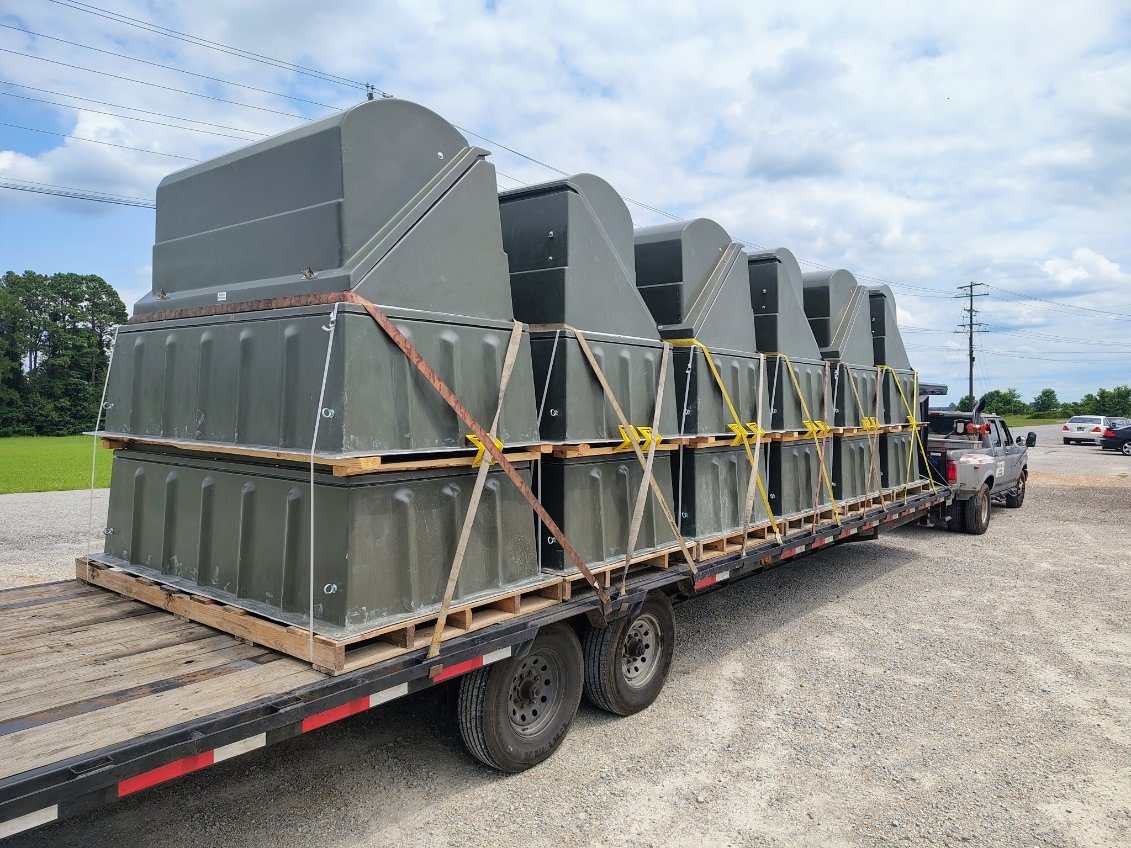
Oversize vs. Overweight vs. Superload
Three terms that get mixed up on quote requests every week:
- Oversize — exceeds a dimensional limit: width, height, or length. Weight can be fully legal.
- Overweight — exceeds gross, axle, or bridge-formula weight limits. Dimensions can be fully legal; a transformer or steel coil can be overweight inside a standard trailer footprint.
- Superload — exceeds what a state will issue on a routine oversize/overweight permit. Each state draws its own line, and crossing it means engineering review, bridge analysis, and an individually approved route instead of an automated permit. Planning starts weeks out, not days. Full breakdown in What Is a Superload?
One move can be all three at once — wide, tall, and heavy is a normal Tuesday in this business.
"Wide Load" vs. "Oversize Load" Banners
Functionally the same warning; legally, the wording matters. Most states specify the banner read OVERSIZE LOAD — black letters on yellow, typically 7 feet long by 18 inches tall with 10-inch lettering, mounted front and rear. "WIDE LOAD" is the older wording, still accepted in some states, but OVERSIZE LOAD is the safe standard nationwide. Overwidth and overhanging loads also carry red or fluorescent orange flags, roughly 18 inches square, at the extreme corners. Banners and flags don't replace the permit — they're a condition of it.
Every State Draws Its Own Lines
The federal numbers set the floor; the states set everything else. Permits are issued state by state, each with its own travel hours (daylight-only is common), weekend and holiday embargoes, escort thresholds, and county or city roads the state permit doesn't cover. A 14-foot-tall load that's legal in Texas becomes a permitted move the moment it crosses into Louisiana at 13'6". A multi-state route means multiple permits with conflicting conditions — the coordination work covered in our oversize load permits guide, and the work we handle before a truck is ever assigned. Have dimensions and weights in hand? Send them over and we'll tell you exactly what your load triggers.
Bottom line
- Oversize starts at anything over 8'6" wide, over 13'6"–14' tall (state-dependent), or beyond legal trailer length.
- Overweight starts above 80,000 lbs gross — or above 20,000 lbs on a single axle, 34,000 lbs on a tandem, or the Federal Bridge Formula limit, whichever hits first.
- Superloads exceed routine permit limits and require state-specific engineering review and individually approved routes.
- Limits and permits are per-state: one route, multiple permits, multiple sets of rules.