Transformers move upright, always. Match the trailer to the shipping weight: flatbed for distribution units, step-deck when height gets tight, RGN for heavy substation units, multi-axle platforms for large power transformers. Mount tri-axial impact recorders, secure only at manufacturer tie-down points, pull overweight permits early, and plan the rigging at both ends before the truck is booked.
A transformer is not general freight. It is top-heavy, it is often full of mineral oil, and the core-and-coil assembly inside the tank does not tolerate impact. You can drop a crate of steel fittings off a dock and lose nothing. Put a hard shock into a transformer and you can shift windings, crack porcelain, and buy yourself a factory teardown — with zero visible damage on the outside of the tank.
That is why transformer moves get planned backwards from the nameplate, not forwards from the truck. Here is how we run them.
Why a transformer is its own problem
Three things separate a transformer from ordinary machinery. First, the center of gravity sits high — the core and coils are dense and mounted well up in the tank, so the load wants to tip. Second, many units ship wet. Smaller transformers travel filled with insulating oil, which adds real weight and can slosh; large power transformers are typically drained and shipped under a dry-air or nitrogen blanket, then filled on site. Third, the internals are shock-sensitive. Manufacturers publish g-force limits and tilt limits for transit, and warranty claims routinely hinge on whether the move stayed inside them.
Weight classes and the trailer that matches
Trailer selection is weight and height math, nothing else. Working buckets:
- Pad-mount and distribution units: a few hundred pounds up to several tons. Standard flatbed, fully legal load. The job is securement and upright handling, not permits.
- Small substation transformers: roughly five to twenty-plus tons. Flatbed or step-deck. Watch height — a flatbed deck sits around five feet off the ground, so a tall unit can push past the 13'6" legal ceiling. A step-deck buys back over a foot of clearance.
- Power transformers in the mid range: once the combined rig approaches the 80,000 lb federal gross limit, you are into overweight permitting and a removable gooseneck (RGN) or lowboy, often with flip axles added to spread the load.
- Large power transformers: multi-axle platform trailers, dual-lane configurations, and superload-class permitting with route surveys and bridge engineering. Some long legs move by rail with trucks handling the first and last miles.
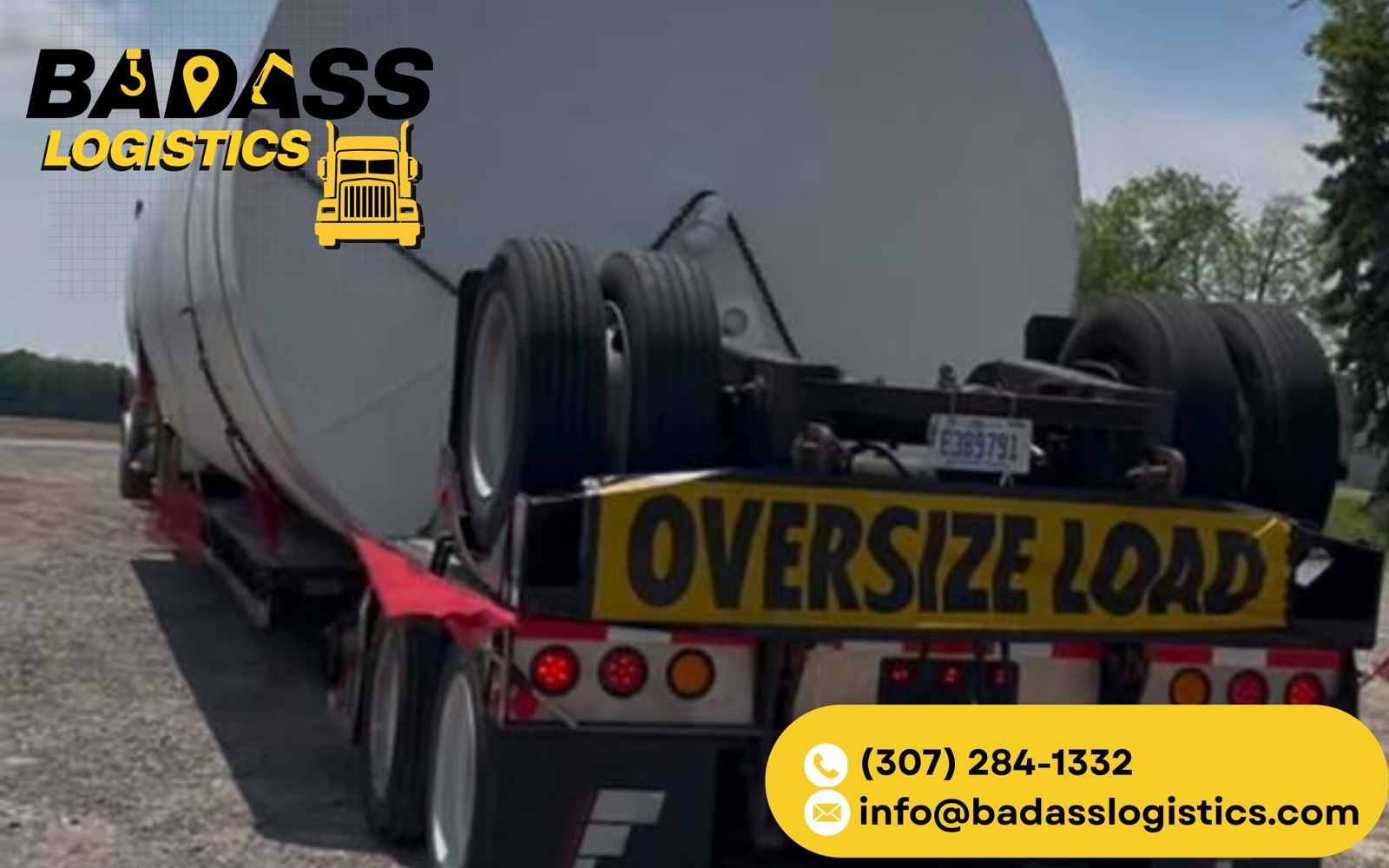
Impact recorders and the upright rule
Every serious transformer move carries a tri-axial impact recorder bolted to the tank. It logs shock events in all three axes for the entire trip, and it gets downloaded at delivery before anyone signs. If the manufacturer's g-limit was exceeded, the receiver knows before the unit is energized — not after a failure in service.
The upright rule is absolute. Transformers travel vertical, inside a tilt tolerance that is often only a few degrees. Laying one over can displace the core, damage internal bracing, and disturb the oil or gas blanket. If a unit will not fit upright on a flatbed, the answer is a lower deck, not a lower angle.
Permits: weight drives the file
Most transformer permit work is triggered by weight before dimensions. Anything pushing the rig past 80,000 lbs gross needs overweight permits in every state it crosses, and axle loadings have to satisfy each state's bridge formula — which is why axles get added even when the trailer could technically carry the weight. Dimensional permits stack on top when the unit exceeds 8'6" wide or 13'6" tall on the trailer. Escorts, curfews, and route restrictions all flow from the permit file. Our permits guide covers the mechanics; the short version is that permits are lead time, and lead time is booked before the truck is.
Rigging on and rigging off
The lift is planned from the transport drawing. Slings go on the manufacturer's lift lugs — nowhere else — with spreader bars sized to keep sling angles inside spec. Depending on site access, that means a hydraulic crane, a gantry system over the pad, or jack-and-slide for the final set. Bushings and radiators are usually removed and crated separately on larger units, because they are the first things to break and the last things you want load-bearing. Securement follows the same logic: chains to designated tie-down points, with blocking and bracing carrying the base, never the cooling fins. Both ends of the move — the haul and the rigging — get coordinated as one plan, because a trailer the destination crane cannot unload is a planning failure, not bad luck.
Bottom line
- Transformers ride upright, inside the manufacturer's tilt limit, every mile.
- Trailer choice is weight and height math: flatbed, step-deck, RGN, then multi-axle platform as the numbers climb.
- Tri-axial impact recorders travel on the tank and get read before sign-off.
- Overweight permitting usually triggers before oversize — file early, route around weak bridges.
- Rig only from designated lift lugs and tie-down points; radiators and bushings carry nothing.
Moving a transformer soon? Send us the nameplate data and the transport drawing and we will coordinate the trailer, permits, and rigging at both ends. Get a quote.